
Choose a purpose. Then choose a printable.
World Kindness Day can be a starting point for a story, a maths discussion, a small paper construction or a picture game. This collection brings together 52 separate digital resources. You do not need to use them all: pick the activity that fits the thinking, materials and time you have.
Below, every resource has its own explanation, two real previews and a direct shop link. The classroom suggestions are ideas you can add yourself; they are separate from the PDF contents listed for each product.
The collection ranges from picture tracing and counting to fraction division and linear equations. Preview the task and use your knowledge of the learners. These are separate purchases, not a single 52-resource bundle.
Reading & writing
A paper craft becomes a literacy task when children have something specific to say. Start with a story you have chosen, rehearse the ideas aloud, then choose a format that makes the thinking visible. These resources offer different ways to retell, describe a character or share a personal response.
Story Retelling Flap Craft
Flaps hide and reveal parts of a planned story retelling.
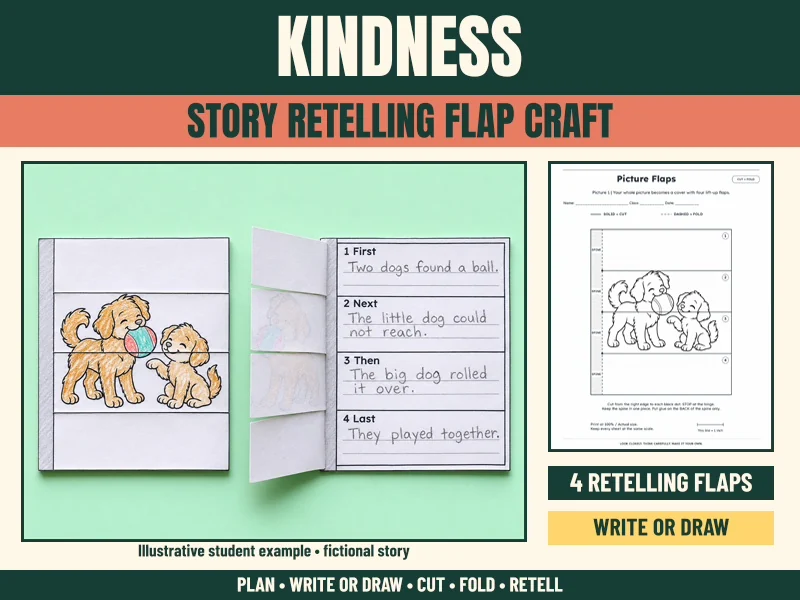
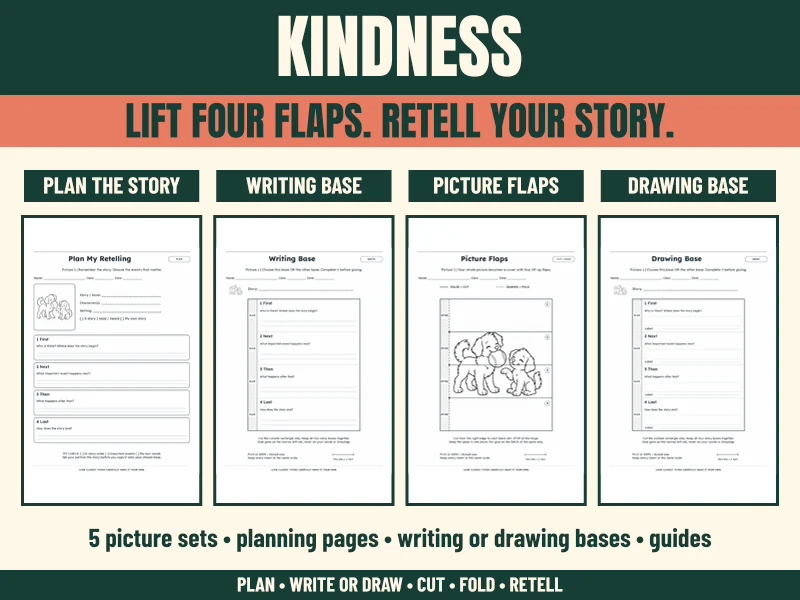
- One 27-page printable PDF
- Five picture-themed sets with retelling planners, writing bases and story-flap assembly templates
How it works. Use a teacher-selected story or create one from a picture. Plan the main events, write a sequenced retelling and attach the flaps to create an interactive craft. A complete reading passage is not included.
Write a short event under each flap after rehearsing it aloud. A partner opens the flaps in sequence and checks whether the retelling is clear.
Accordion Retelling Craft
A folding format gives a retelling a clear sequence that can be opened and read aloud.
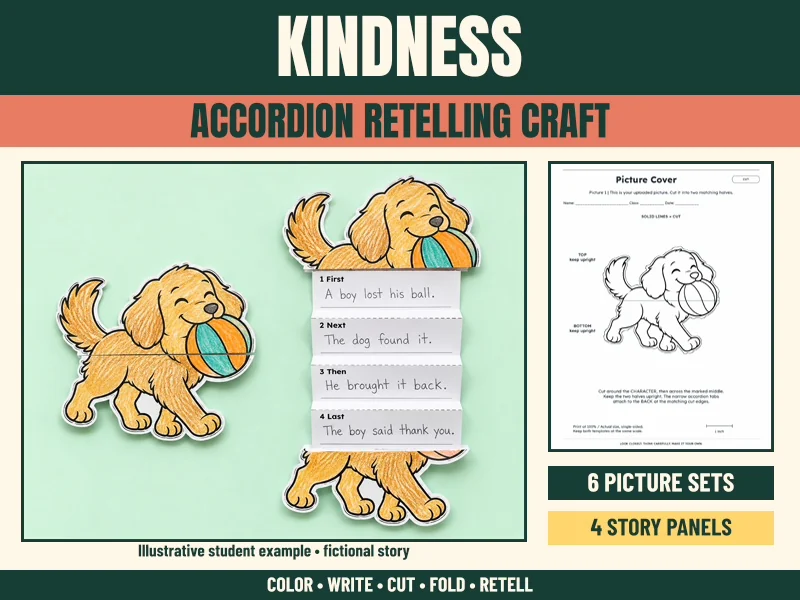
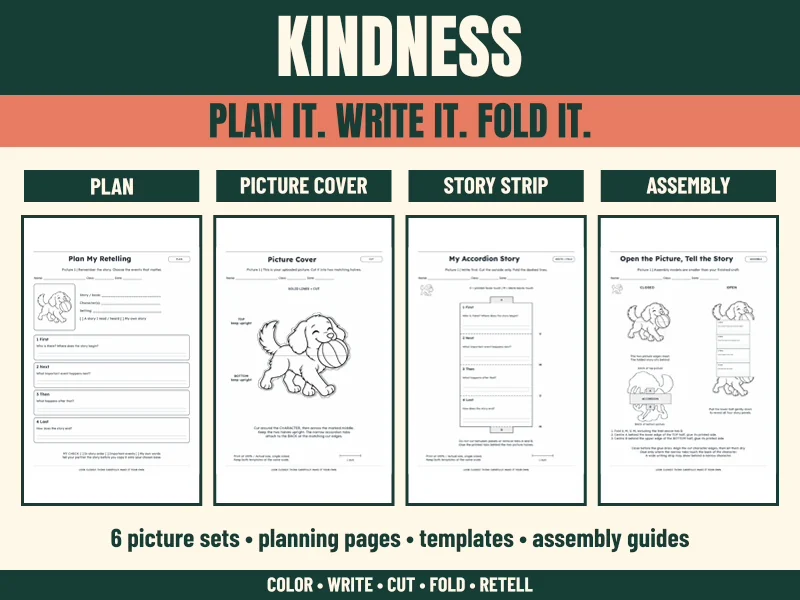
- 26-page PDF
- Six picture-based craft sets
- Four story-part sections for organizing a retelling
- Printable templates for colouring, writing, cutting and folding
How it works. Read a kindness-themed story, talk about the key events, then invite learners to plan and write their retelling. Children can colour the pictures, cut out the templates and fold their finished work into an accordion craft. Use the pieces for a classroom display, paired storytelling or a take-home reading activity.
After a read-aloud, rehearse one event per story section. Ask a partner to open the accordion and retell the events using their own words.
Accordion Storybook Craft
Blank panels in an accordion storybook leave room for an original short sequence.
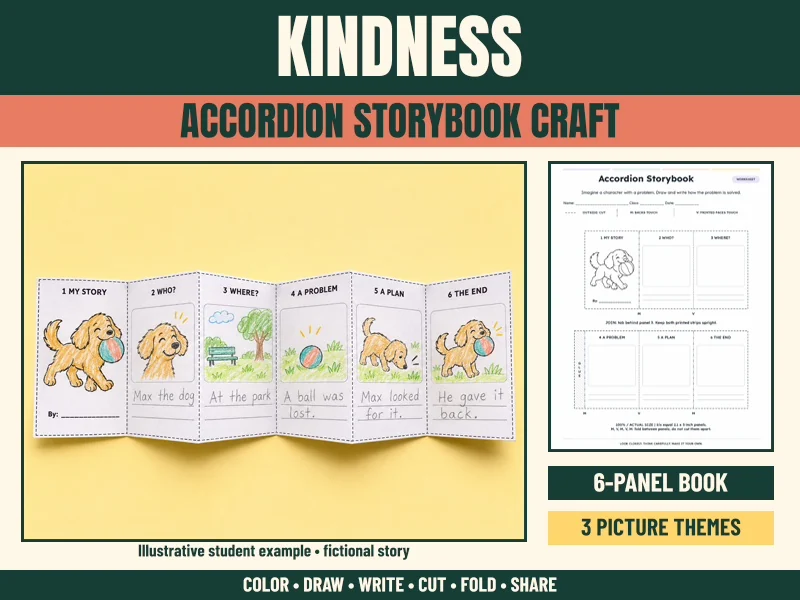
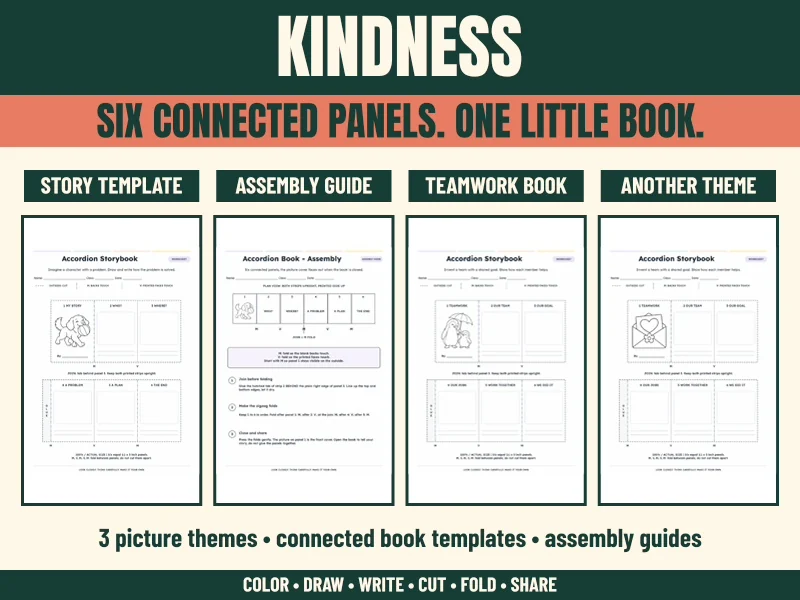
- One 8-page printable PDF
- Three picture-based accordion storybook templates with assembly guidance
How it works. Draw or write a short sequence in the panels, colour the pictures, cut out the book and fold it into an accordion. Use the blank panels for an original kindness story.
Create a story in which someone notices a problem, offers help and checks how the other person feels. Plan the sequence aloud before filling the panels.
Character Analysis Writing Activities
The analysis pages separate observation from inference rather than asking for an unsupported character label.
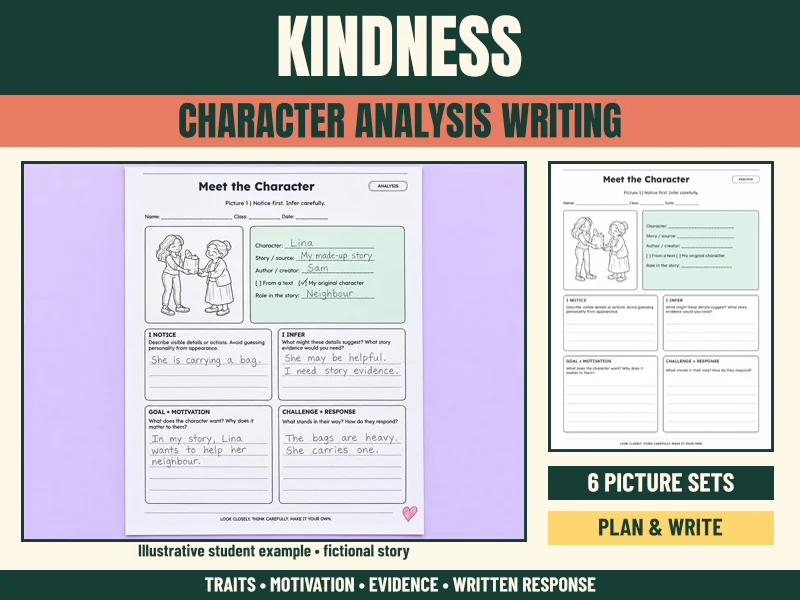
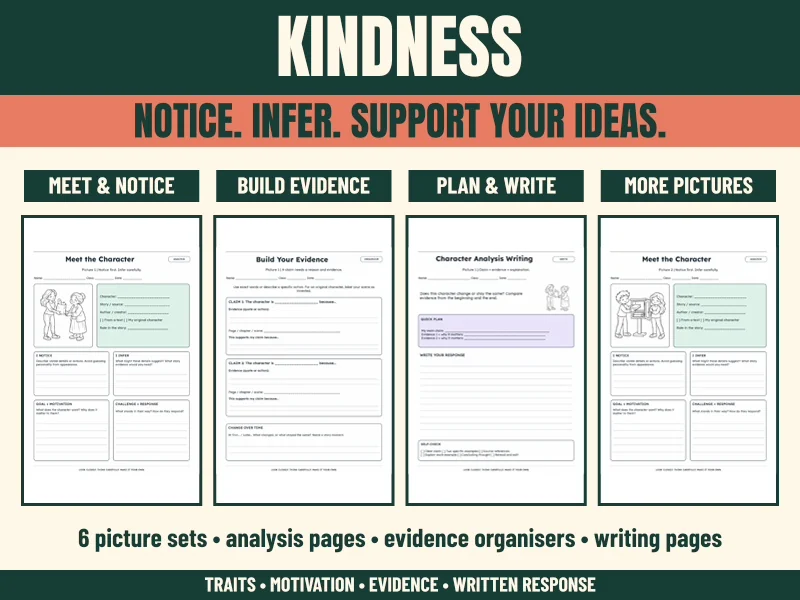
- One 20-page printable PDF
- Six three-page picture sets with character observation, inference, traits, motivation, evidence and writing sections
How it works. Use a teacher-selected story or discuss the picture. Ask learners to distinguish what they notice from what they infer, support their ideas with evidence, then develop a written character response. A complete reading passage is not included.
Create two spoken stems: “I notice…” and “I think… because…”. Use a picture or your own selected story to practise supporting a trait with evidence.
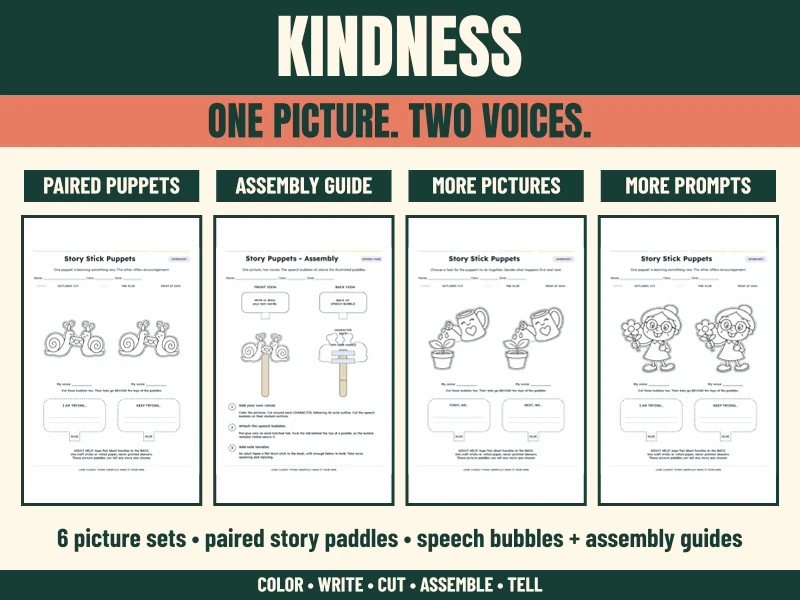
Stick Puppet Craft
A puppet adds a speaking role to the colouring and assembly task.
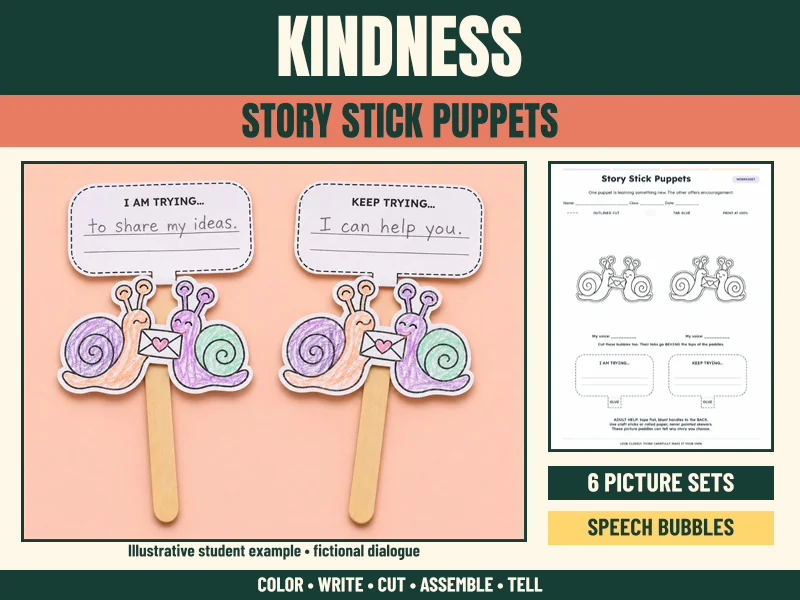
- One 14-page printable PDF
- Six picture sets with stick-puppet templates, speech or writing spaces and assembly guidance
How it works. Colour and cut the puppets, attach them to craft sticks and use them to act out a helpful conversation or retell a kindness story.
Act out asking before helping: one puppet offers support and the other explains what they need. Swap roles so both partners practise listening.
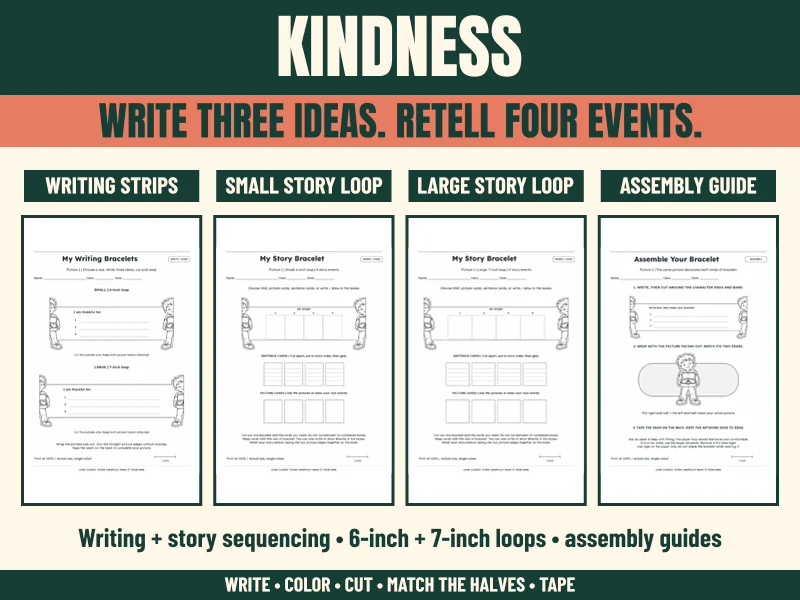
Picture Bracelet Writing Craft
A short written response gives a paper bracelet a message as well as a picture.
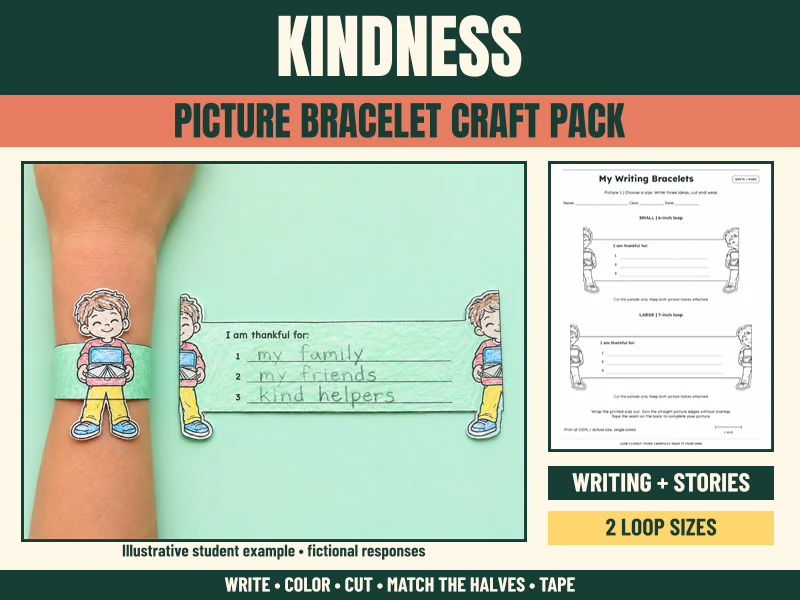
- One 26-page printable PDF
- Six picture-based craft sets combining short writing prompts, bracelet templates and assembly instructions
How it works. Write a short response about a character or helpful action, decorate the matching bracelet and cut and join the paper band.
Draft a sentence describing a helpful action before decorating the band. Have a partner read it back to check that the meaning is clear.
All About Me Worksheets
Personal responses can open a conversation about getting to know classmates.
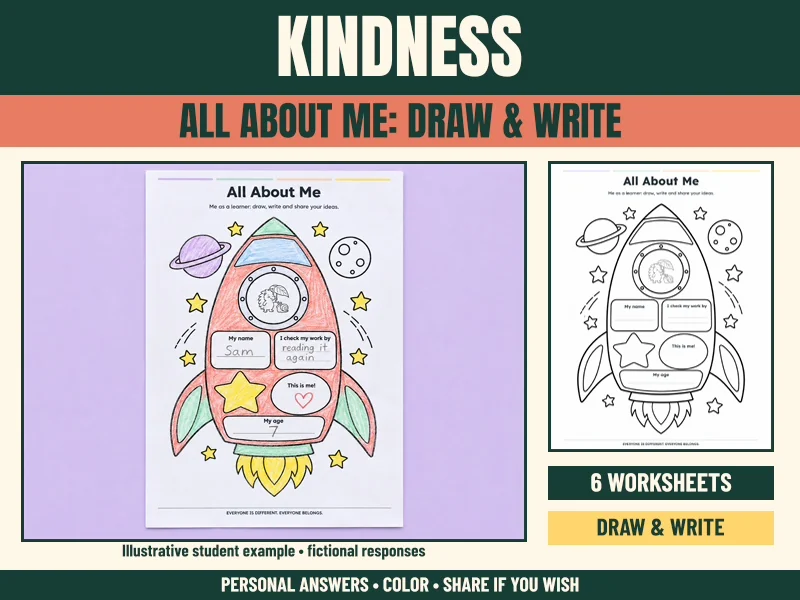
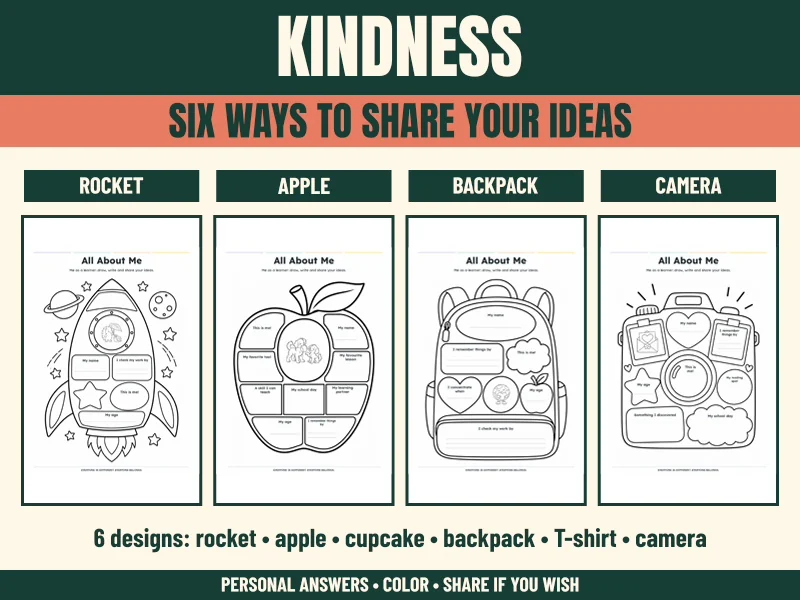
- One 8-page printable PDF
- Six shaped All About Me writing templates: rocket, apple, cupcake, backpack, T-shirt and camera
How it works. Invite children to complete their personal responses and decorate a chosen shape. Add a teacher-led discussion about listening to others and valuing classmates.
Let partners choose one response they are comfortable sharing. Each partner recalls something they learned about the other person without making assumptions from the shape chosen.
Reading Bookmarks
A bookmark gives a short creative activity a useful place in an everyday reading routine.
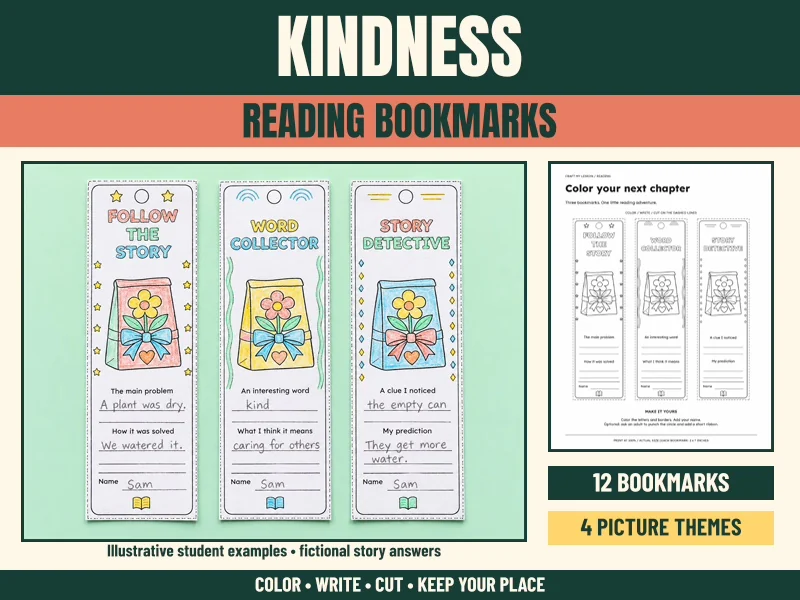
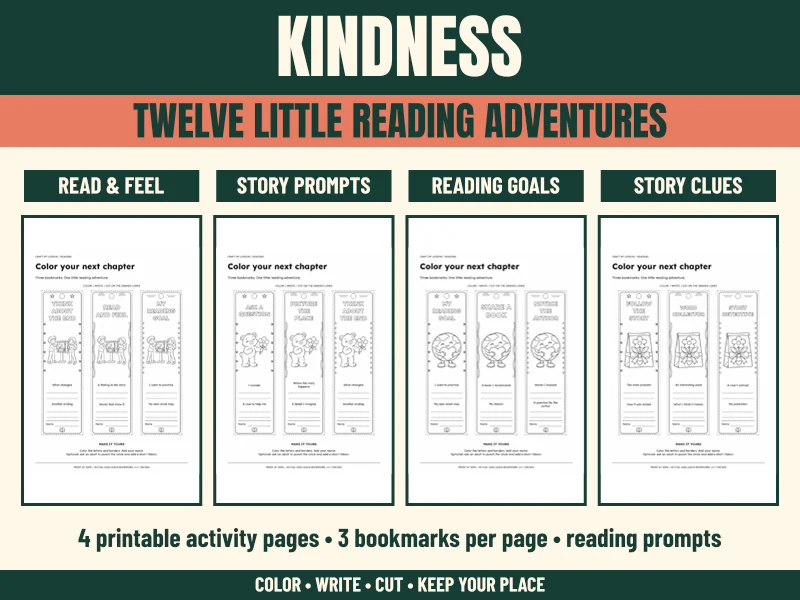
- One 6-page printable PDF
- 12 printable bookmarks featuring four kindness-themed pictures in three versions
How it works. Let learners choose and colour a bookmark, then cut it out for use with a favourite book. Pair the activity with a read-aloud and discussion about helpful actions.
After a read-aloud, ask children to name one helpful action in the story before decorating their bookmark. Revisit that action when the bookmark next marks a page.
Draw Write and Playdough Mats
Drawing, writing and playdough offer three ways to respond to a picture.
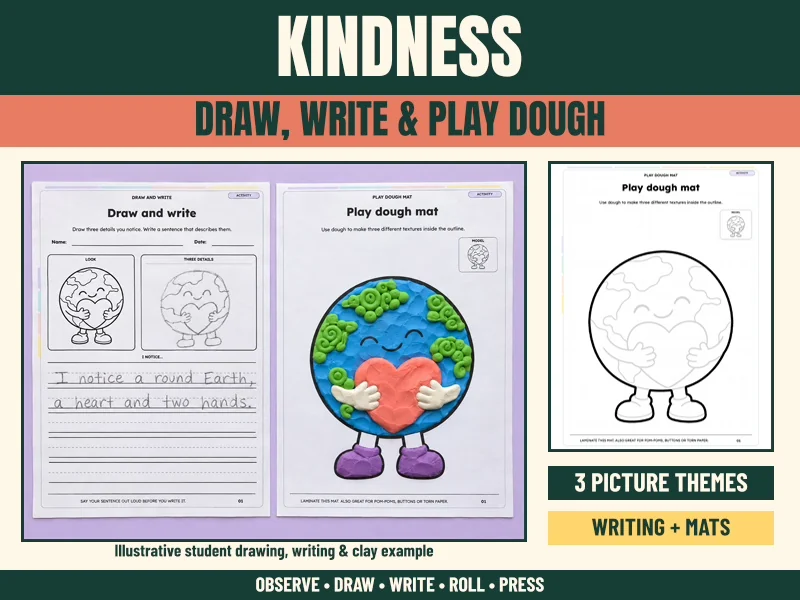
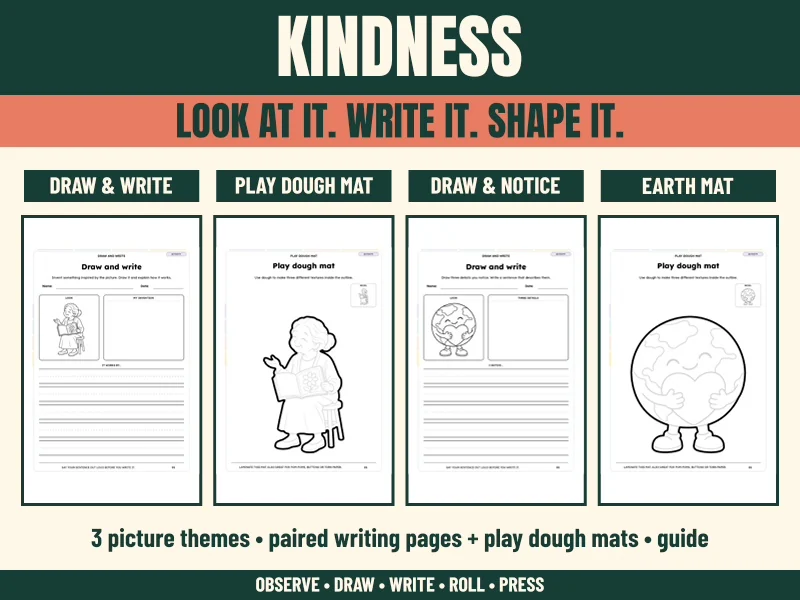
- One 8-page printable PDF
- Three picture sets combining a drawing-and-writing worksheet with a matching playdough mat
How it works. Look at the small model, draw your own version and write a word or sentence. Use the matching mat to shape the picture with playdough.
Use the mat for a small-group vocabulary task: shape a detail, name it, then draw or write a matching word on the paired worksheet.
Maths & number sense
The World Kindness Day maths resources span very different tasks, from counting pictures to solving linear equations. Treat the theme as a shared setting, then choose a page that matches what your learners are studying. There is no need to give everyone the same worksheet simply because the covers match.
Counting Worksheets
The counting formats let children practise keeping track of objects in a picture group.
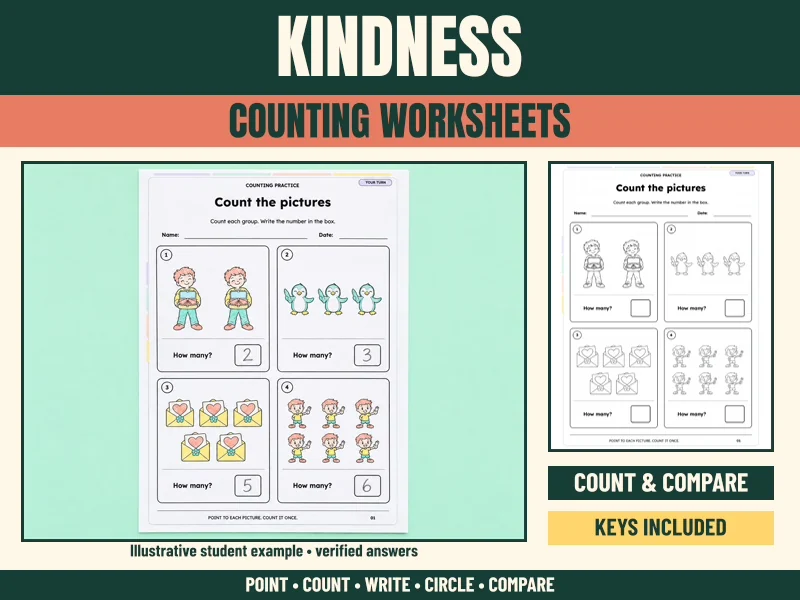
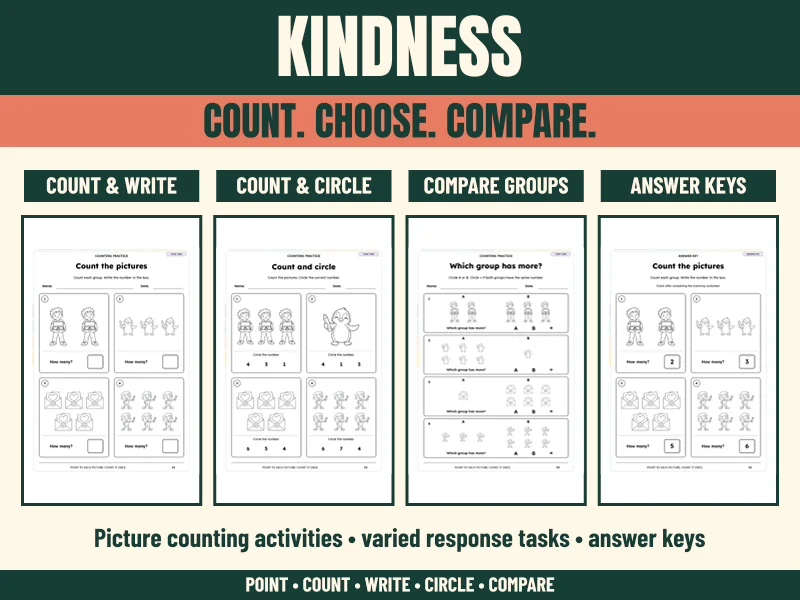
- One 26-page printable PDF
- Picture-counting activities with count-and-write and find-and-count formats, plus completed answer pages
How it works. Count each picture group, record the number, then compare the results with the answer pages. Talk about the helpful actions shown in the illustrations.
Ask learners to mark or point to each object once as they count. Compare two counting routes and check whether the total stays the same.
Picture Addition and Subtraction Worksheets
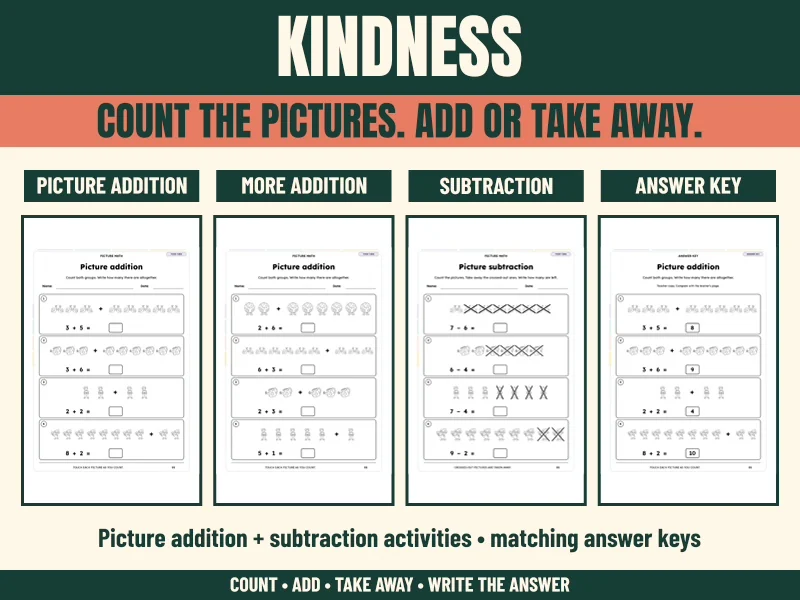
Picture groups and ten frames connect visible quantities to addition and subtraction.
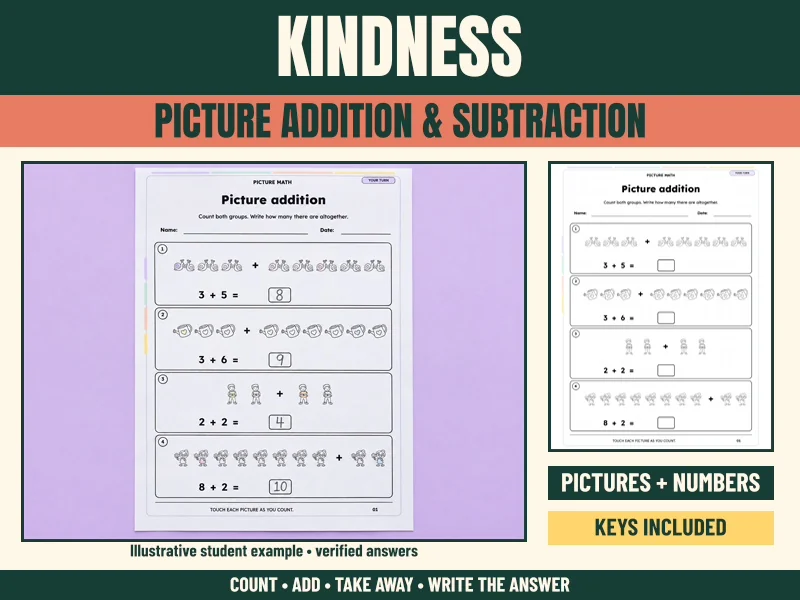
- One 14-page printable PDF
- Picture addition, picture subtraction and ten-frame activities with completed answer pages
How it works. Count the picture groups, combine or cross out objects, write the result and use the ten frames to explore how many more are needed.
Model combining two groups of counters, then removing some. Ask which action matches the printed question before children record a result.
I Spy Count and Graph Worksheet
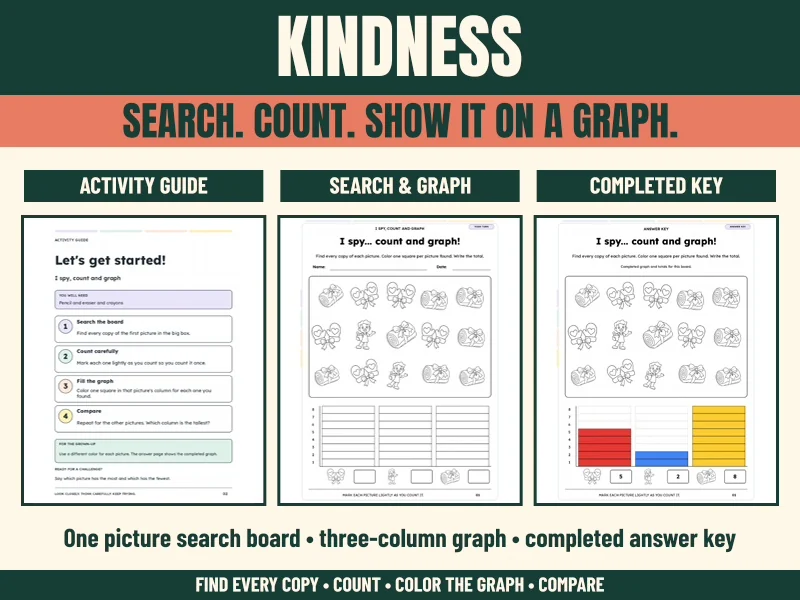
The search sheet connects picture counting with a bar graph.
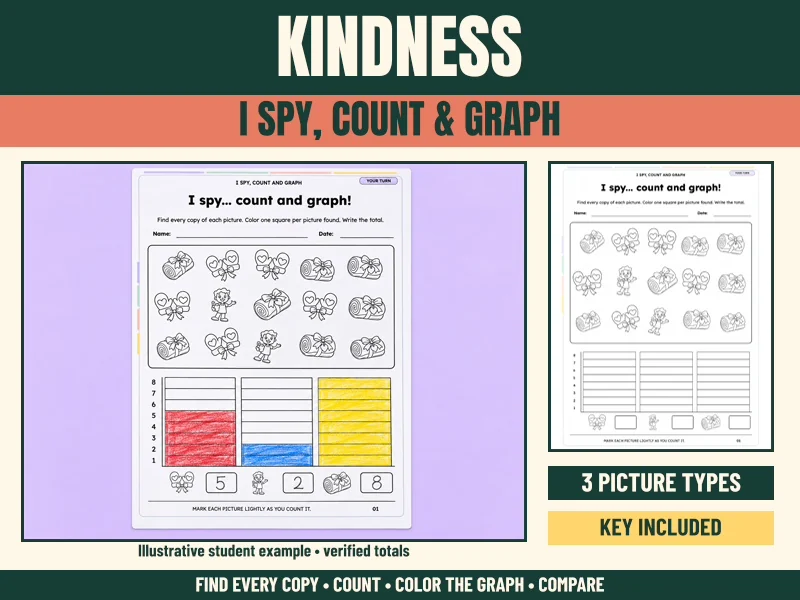
- One 4-page printable PDF
- One picture-search counting sheet and one completed graph answer page, plus introductory guidance
How it works. Find each of the three picture types, count carefully, record the totals and colour the matching bars. Compare which picture appears most or least.
Assign a colour to each picture type and mark each counted item once. Ask which bar is tallest and how its height relates to the recorded total.
Pattern Building Worksheets
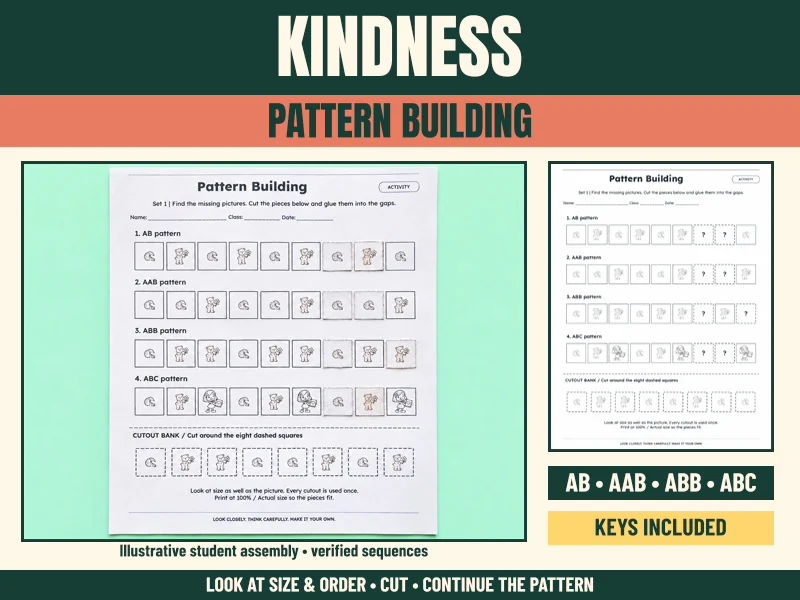
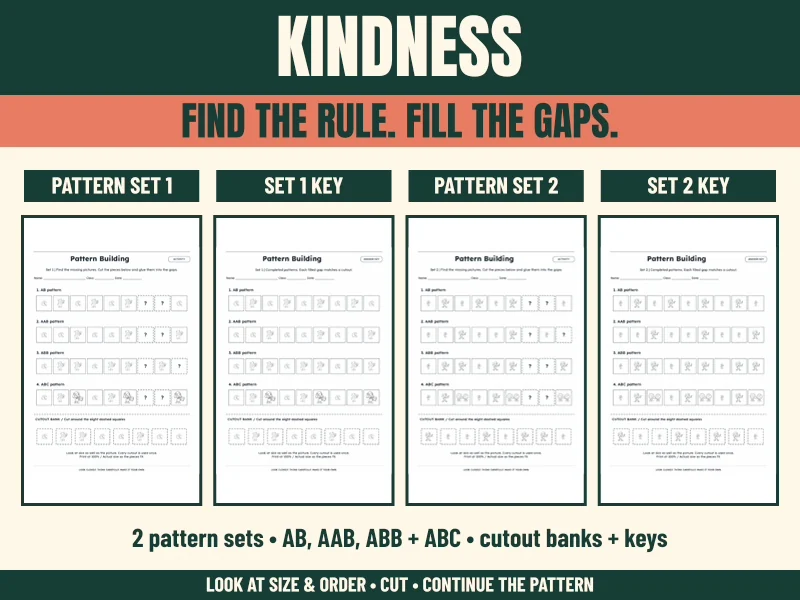
AB, AAB, ABB and ABC patterns invite learners to identify a repeating unit.
- One 6-page printable PDF
- Picture-pattern worksheets covering AB, AAB, ABB and ABC patterns with cut-and-paste picture choices
How it works. Read each repeating sequence, name its pattern and choose the pictures needed to complete the empty spaces.
Say the pattern aloud and mark one full unit before choosing the missing picture. Invite a partner to extend the same rule with classroom objects.
Number Representation Math Craft
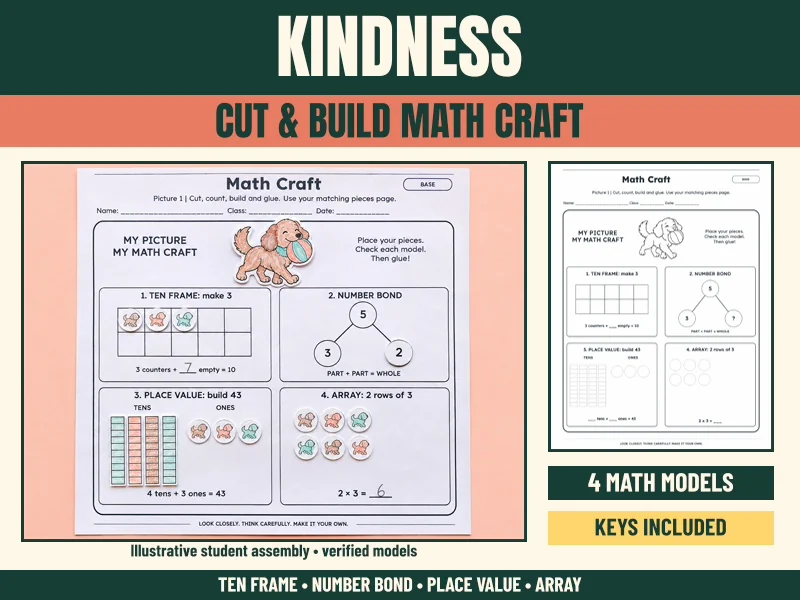
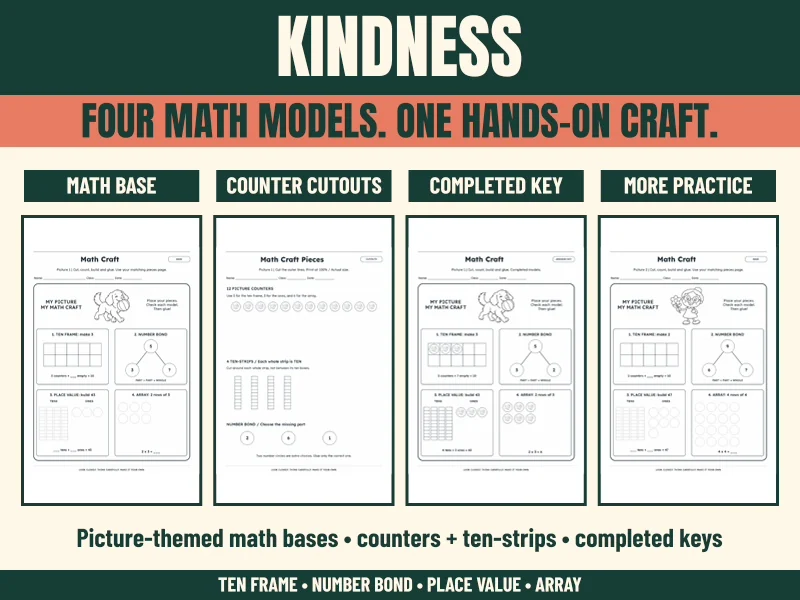
Several number representations become parts of one picture-themed math craft.
- One 17-page printable PDF
- Five picture-themed math-craft sets with ten frames, number bonds, place value and arrays, plus assembly pages and completed examples
How it works. Represent each number in different ways, complete the sections and assemble a picture-themed math craft. This download contains printable worksheets; it does not include generator software.
Choose a number appropriate for the group and explain how a ten frame and a number bond can show the same quantity. Check the representations before assembling the craft.
Place Value Worksheets
The worksheet sets focus on charts, expanded form and digit values.
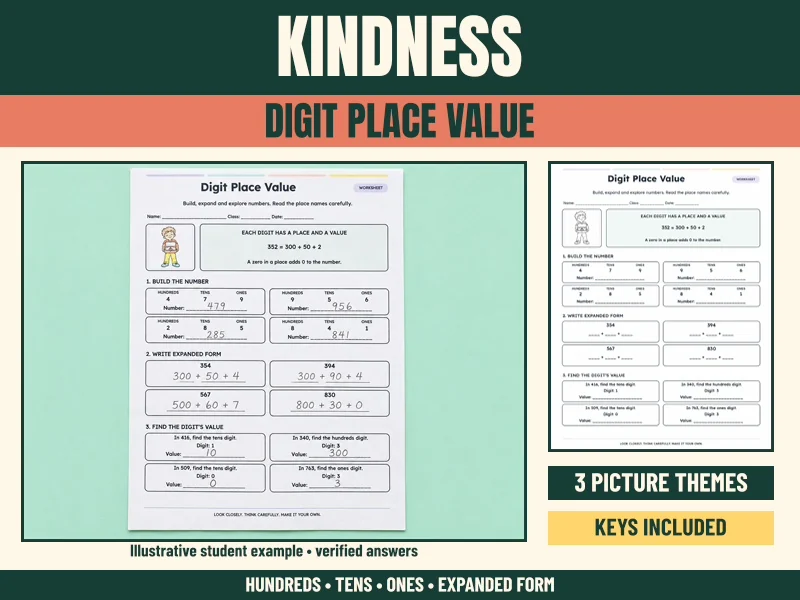
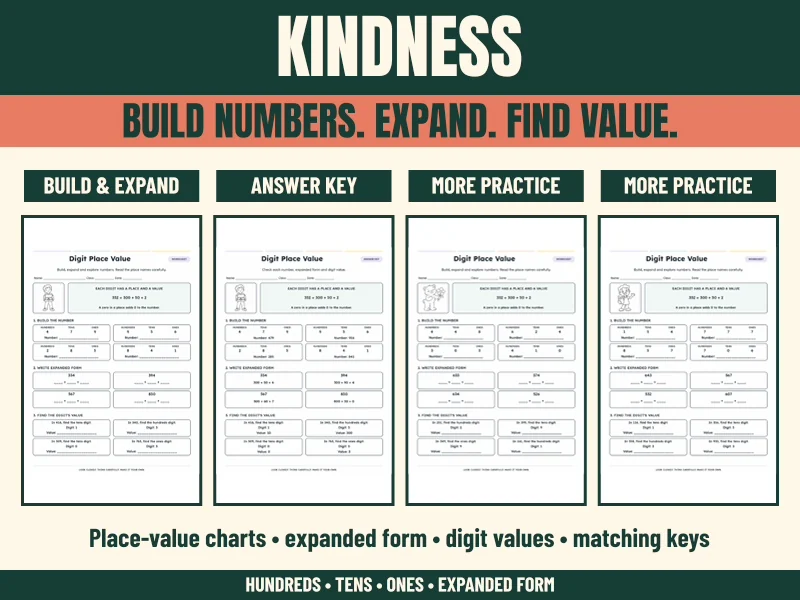
- One 8-page printable PDF
- Three worksheet sets covering place-value charts, expanded form and identifying the value of a digit, with answers
How it works. Read each chart, write the expanded form and identify digit values. Use the completed pages to check the work together.
Build a teacher-chosen number such as 243 with a place-value representation. Ask what changes when the 4 moves from the tens column to the ones column.
Multiplication Arrays Worksheets and Craft
Cut-out pictures make the rows and columns of an array tangible.
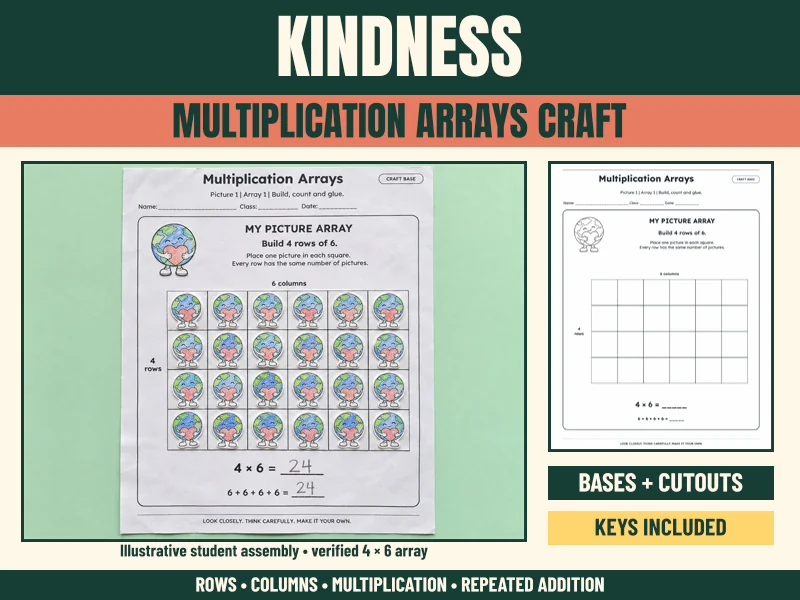
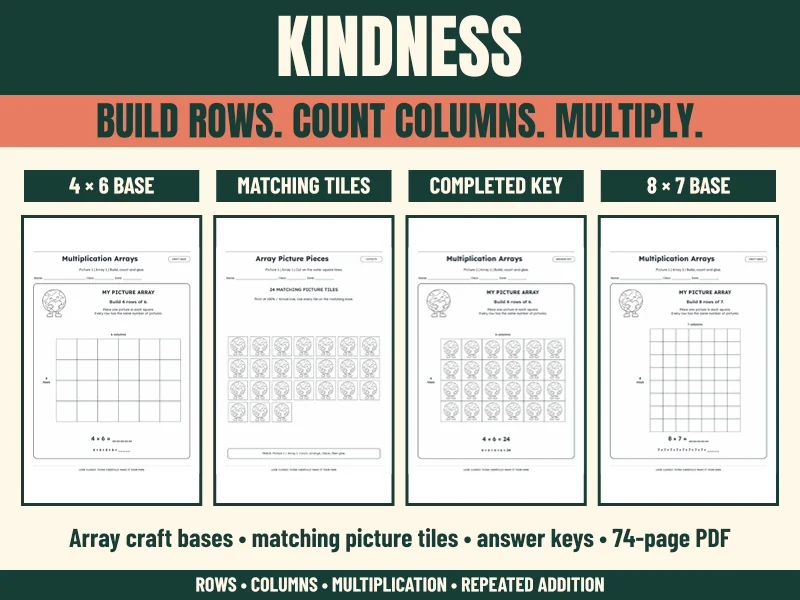
- One 74-page printable PDF
- Six picture-themed sets with array-building grids, picture pieces and completed examples
How it works. Cut out the small pictures, build the requested rows and columns on the grid and record the matching multiplication and repeated-addition equations.
Build three rows of four with counters first. Then compare the arrangement with four rows of three and discuss the equal total before using the printable array tasks.
Picture Multiplication Worksheets
Equal-group pictures connect repeated quantities with multiplication notation.
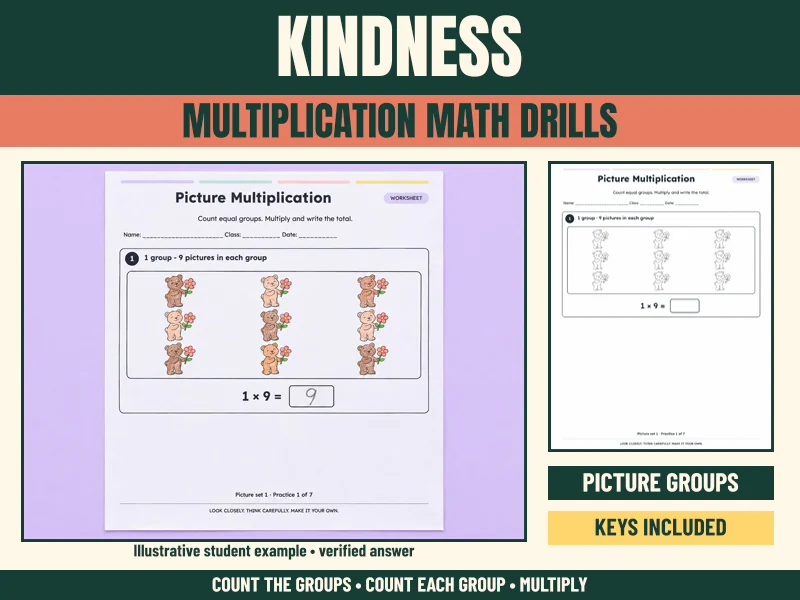
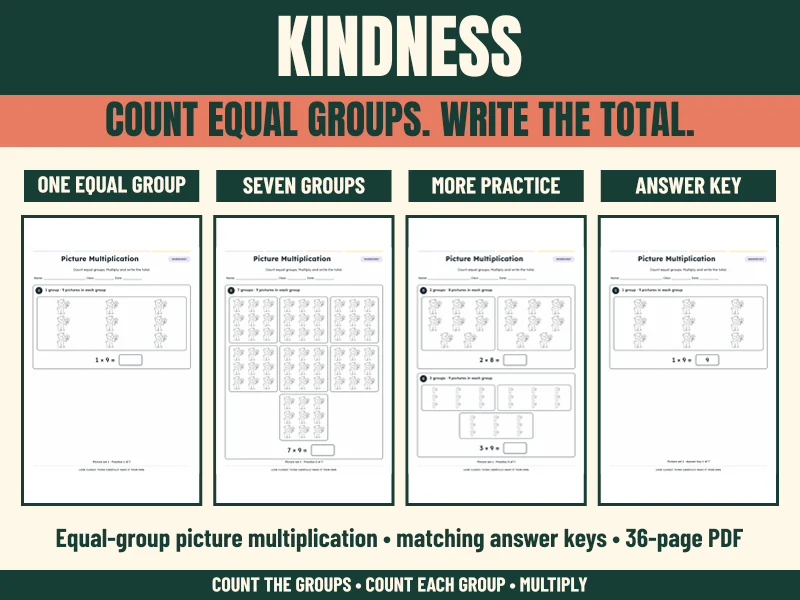
- One 36-page printable PDF
- Three picture-themed sets with equal-group multiplication worksheets and completed answers
How it works. Count the number of groups and the pictures in each group, then complete the multiplication equation and check the answer.
Ask learners to circle each group, name how many groups there are and count the items in one group. Use those quantities to explain the equation.
Dividing Fractions Anchor Charts and Practice
The fraction-division sets connect visual explanations with written practice.
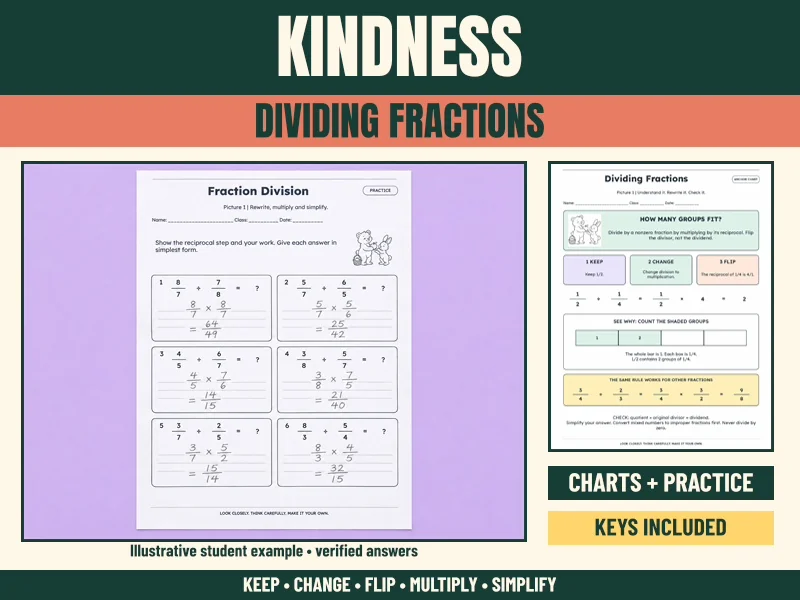
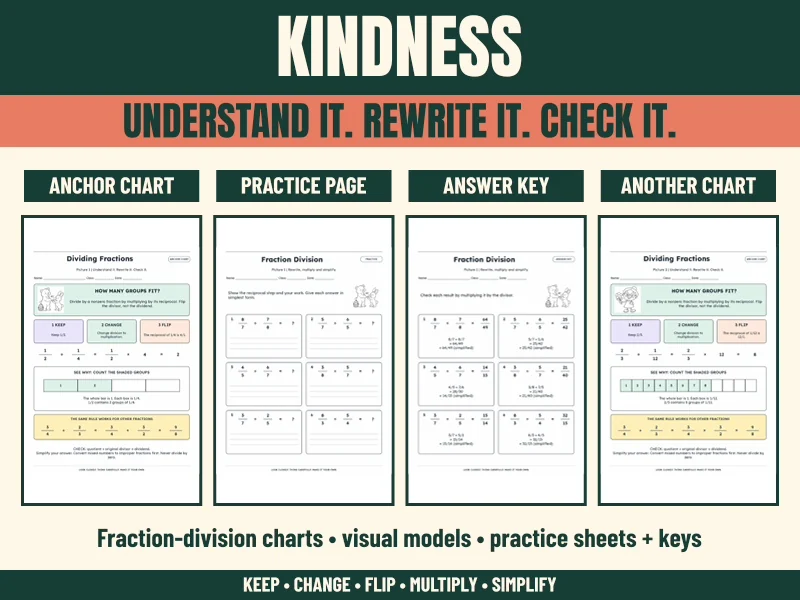
- One 17-page printable PDF
- Five picture-themed sets with visual fraction-division explanations, practice questions and answers
How it works. Model division as finding how many groups fit, discuss the visual examples, then practise the invert-and-multiply method and check the answers.
Use a separate example such as “How many halves fit in two wholes?” Build it visually before writing 2 ÷ 1/2 = 4. Check that learners understand the groups before applying a procedure.
Linear Equations Colour and Draw
This is an algebra option for learners who are already working with linear equations.
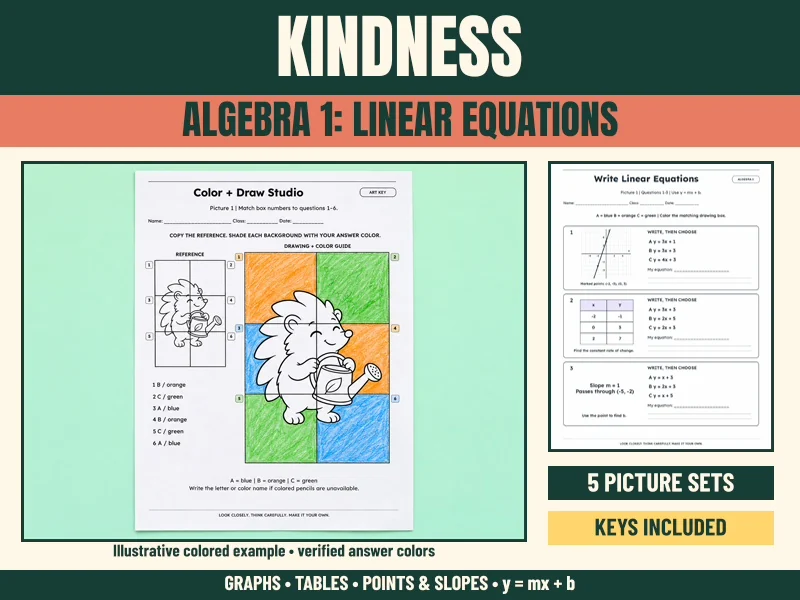
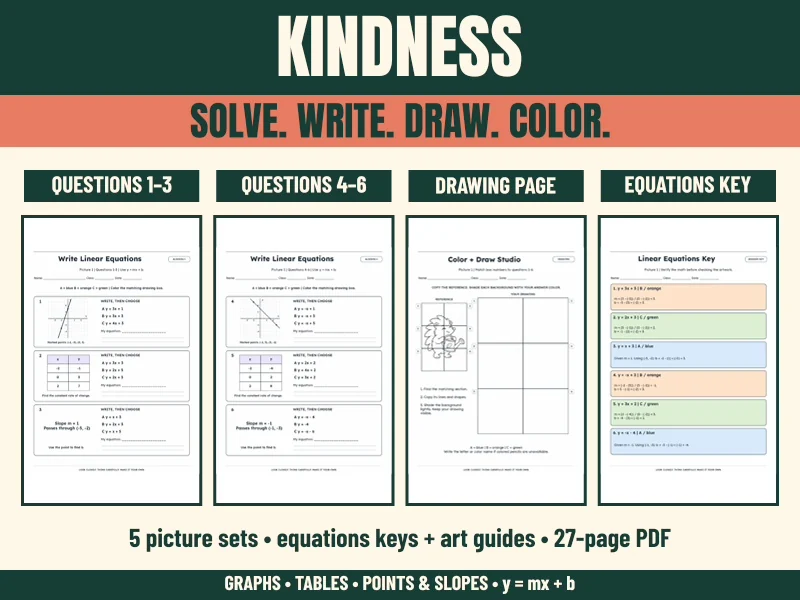
- One 27-page printable PDF
- Five picture sets with six linear-equation questions per set, drawing tasks and answer/art keys
How it works. Solve the algebra questions, use the activity directions to colour or complete the picture, then compare with the provided keys.
Model a separate equation such as 2x + 3 = 11, and check x = 4 by substitution. Then use the printed questions at the appropriate level.
Paper crafts
A finished paper object gives children something to show, describe and take home. Choose one construction challenge at a time: folding an agamograph, joining a basket net or assembling a spinner. Keep the kindness conversation specific by asking what helpful action a picture could represent.
Agamograph Craft
An agamograph makes the same paper construction reveal alternating pictures from different viewpoints.
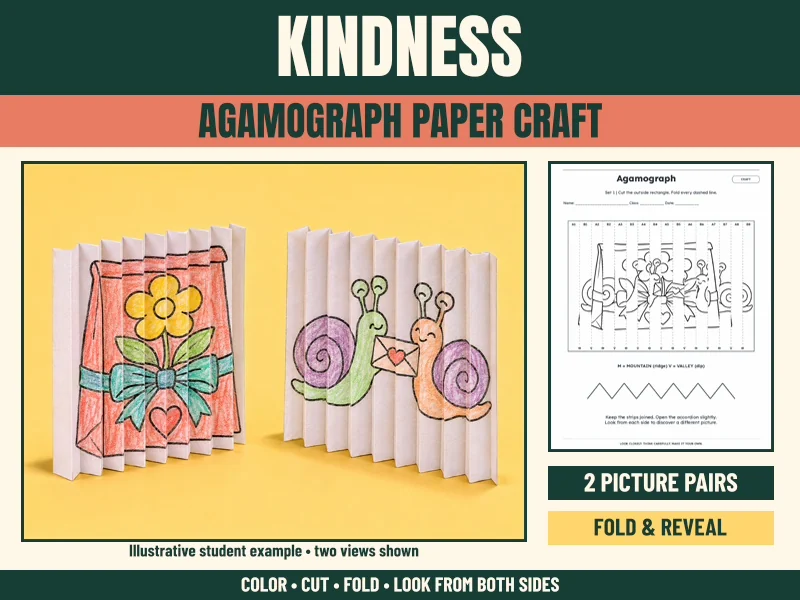
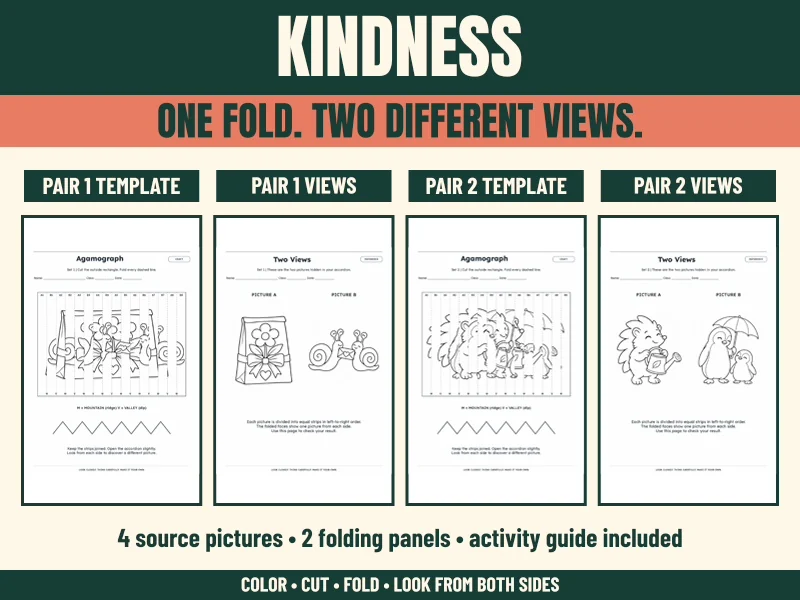
- One 6-page printable PDF
- Two paired agamograph designs using four kindness-themed pictures
How it works. Colour the picture strips, cut and assemble the sheets, then fold along the guides. View the finished craft from different sides to reveal the alternating images.
Set the completed craft on a table. Invite a partner to describe what changes as they look from each side, then connect each picture to a helpful action.
Gift Basket Paper Craft
A basket net introduces a simple cut, fold and join construction.
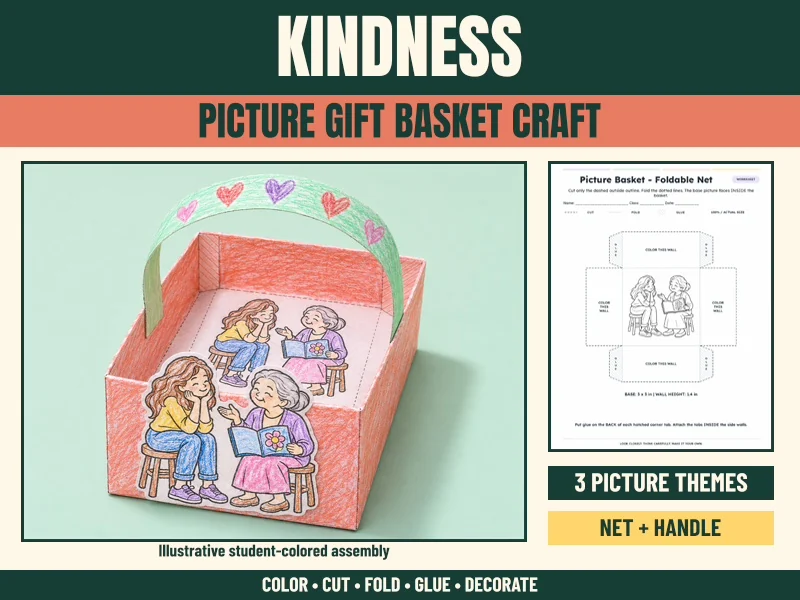
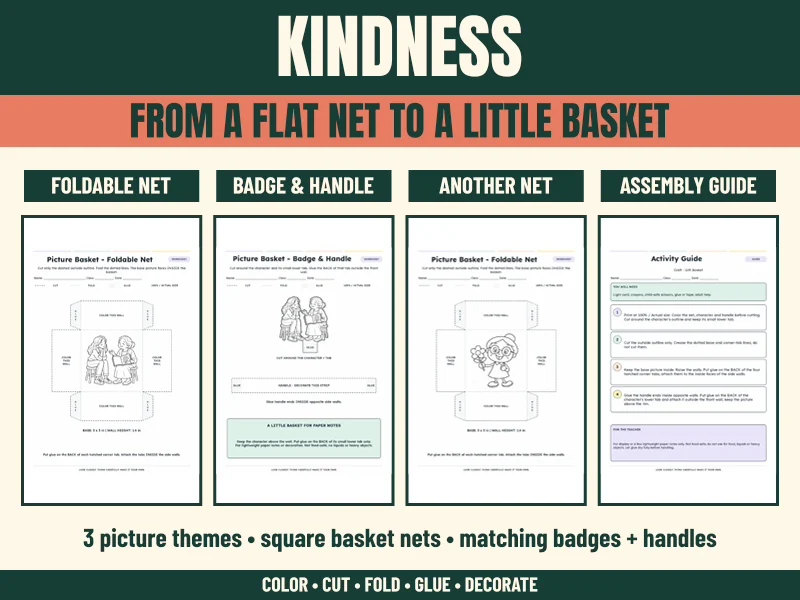
- One 8-page printable PDF
- Three picture basket designs with foldable nets, decorative badges and handles
How it works. Colour the templates, cut around the outside, fold the panels and glue the tabs. Add the handle and badge to make a small paper basket for a classroom kindness activity.
Use the finished paper basket to hold small teacher-supplied appreciation notes. Ask writers to describe a specific helpful action rather than a general compliment.
Paper Lantern Craft
Paper panels and a handle become a decorative lantern for a display.
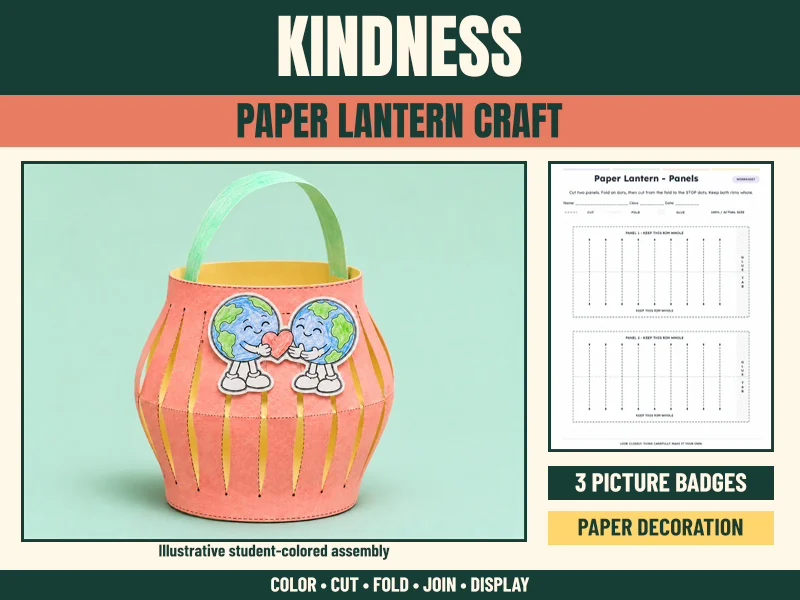
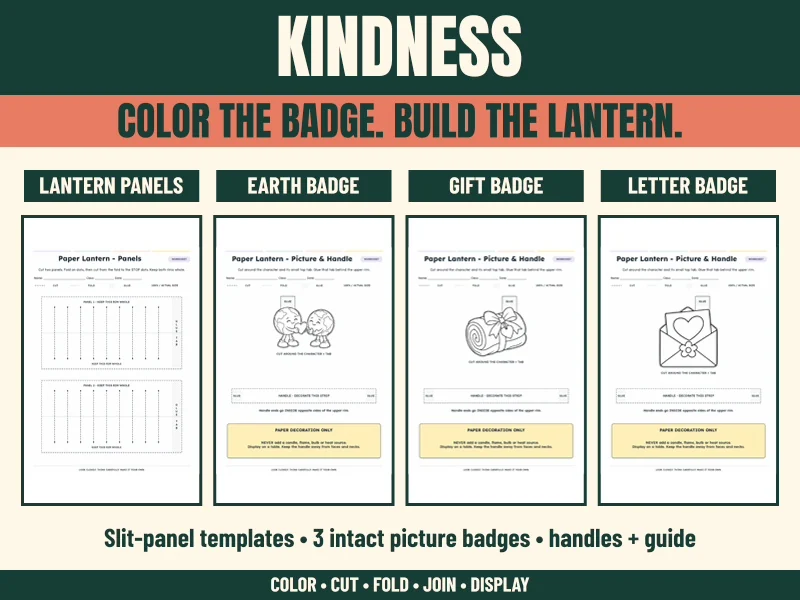
- One 8-page printable PDF
- Three kindness-themed lantern designs with slotted paper panels, picture pieces and handles
How it works. Colour and cut the panels, fold and join the paper to create a decorative lantern, then add the handle. This is a paper decoration only; keep it away from flames and heat.
Invite children to explain one kindness picture on their finished lantern during a gallery walk. Use it only as a paper decoration, away from heat or flames.
Picture Spinner Craft
The rotating window turns four pictures into repeatable speaking prompts.
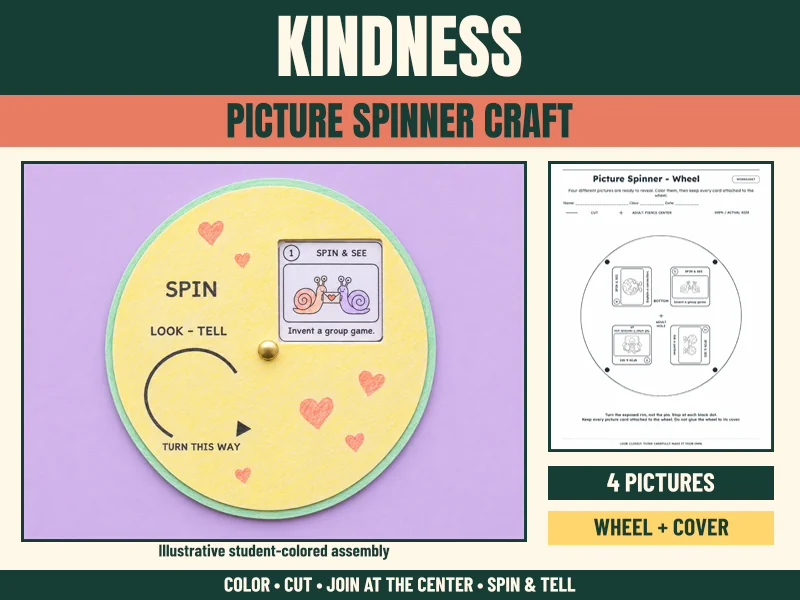
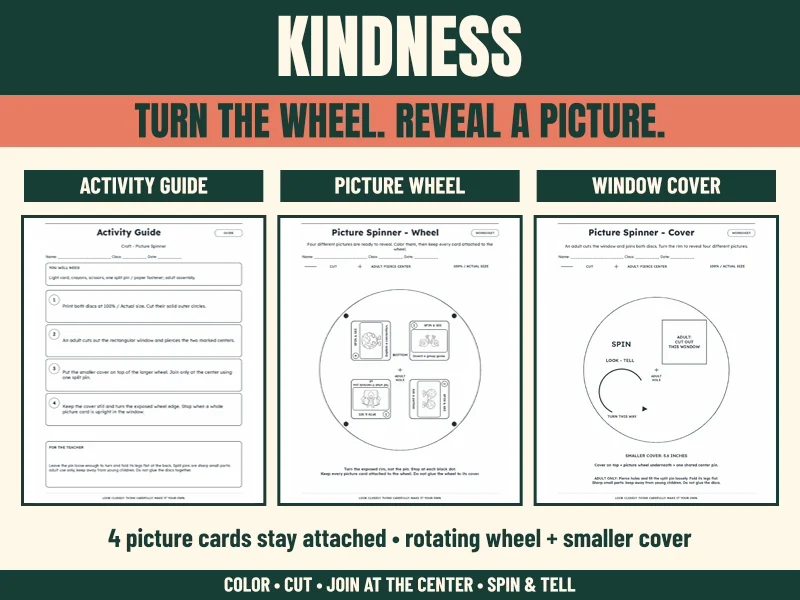
- One 4-page printable PDF
- A picture wheel with four kindness-themed images, a matching cover and an activity guide
How it works. Colour the wheel, cut out the pieces and window, then attach the centre with a split pin. Turn the spinner and use each revealed picture as a speaking or storytelling prompt.
Spin once, describe the visible action, then suggest one sentence the character might say. Ask a partner to add a possible next event.
Crown Craft
An adjustable band turns the picture template into a wearable paper crown.
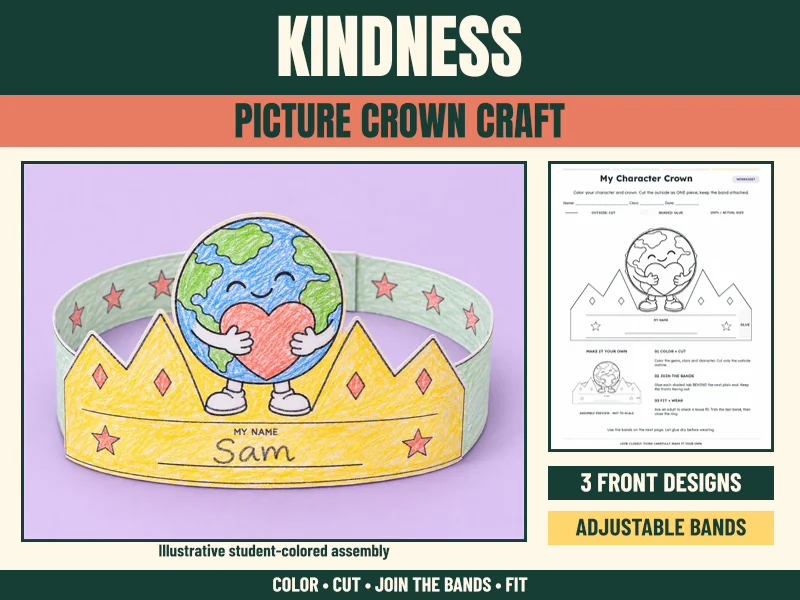
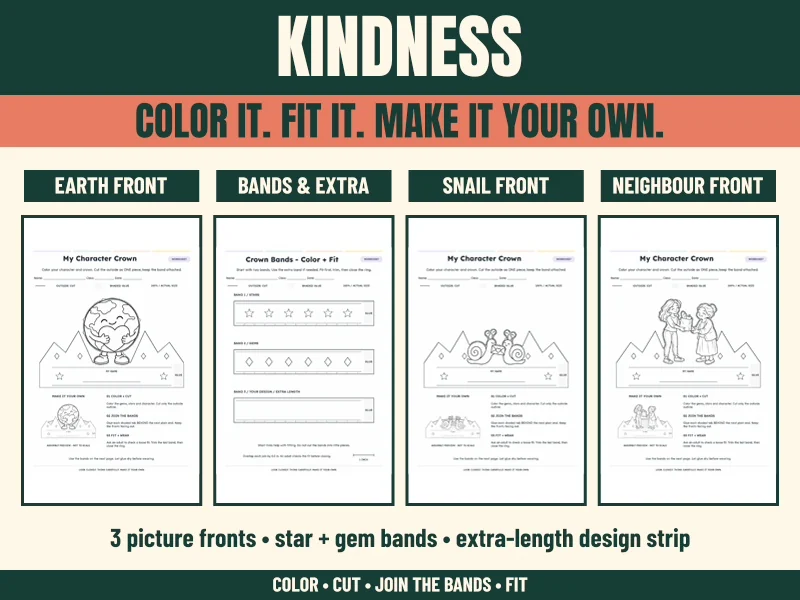
- One 8-page printable PDF
- Three picture crown designs with adjustable band strips and assembly guidance
How it works. Colour the chosen crown, cut the pieces, measure the band and join it to fit. Use the finished crowns during a kindness celebration or classroom sharing circle.
During a sharing circle, invite children to describe one kind action they would like to try. Make participation optional and celebrate concrete examples.
Fold and Reveal Picture Activity
Opening one flap at a time makes observation and prediction part of the activity.
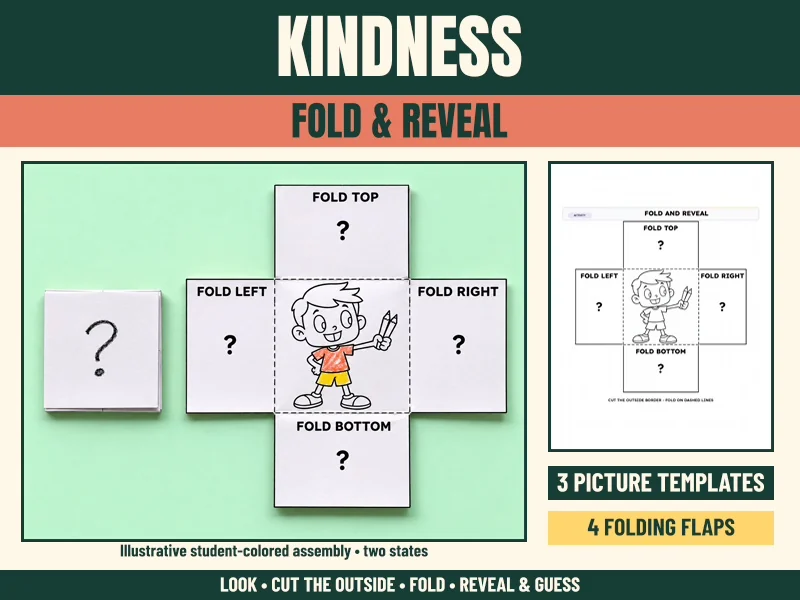
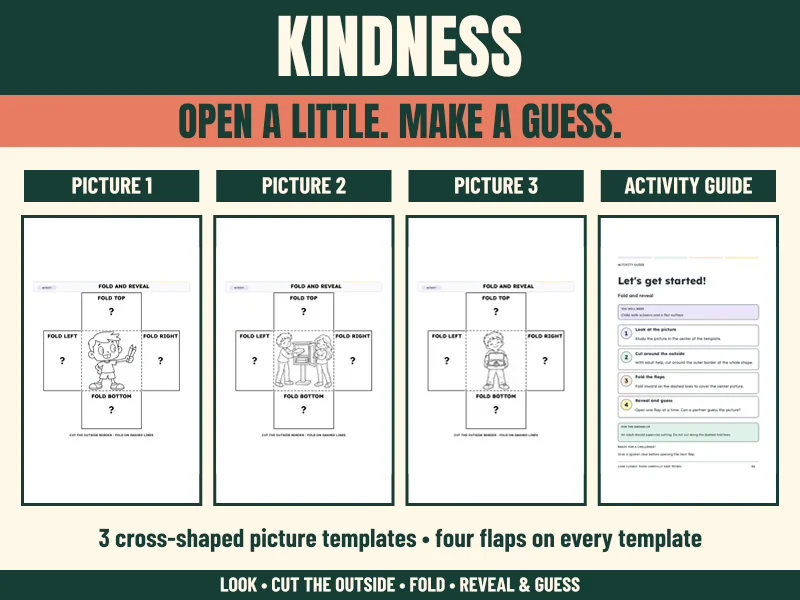
- One 5-page printable PDF
- Three kindness-themed fold-and-reveal picture sheets and instructions
How it works. Cut around a chosen sheet, fold the marked flaps over the central picture, then reveal sections gradually while classmates guess and describe the image.
Reveal a small section and ask what can be seen for certain. Open another flap and let children revise their guesses using the new detail.
Picture Rosette Craft
A circular centre and ribbon tails form a simple paper rosette.
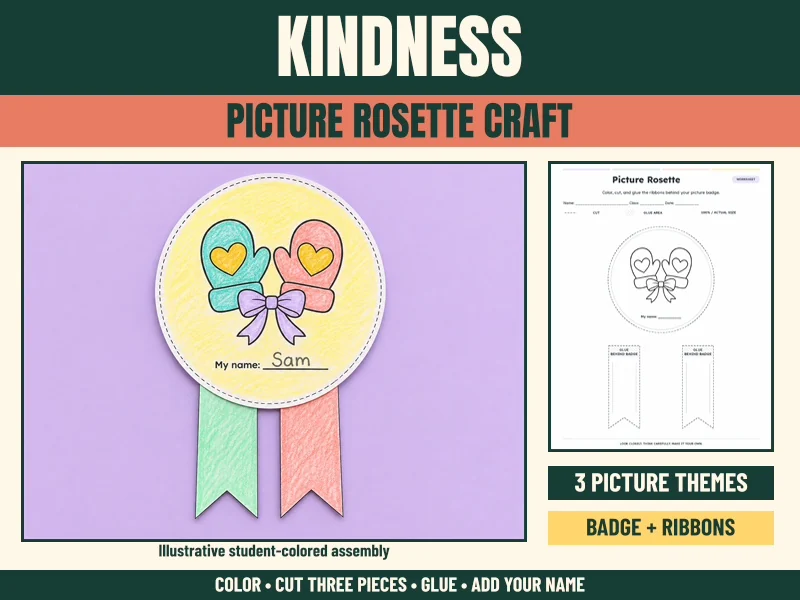
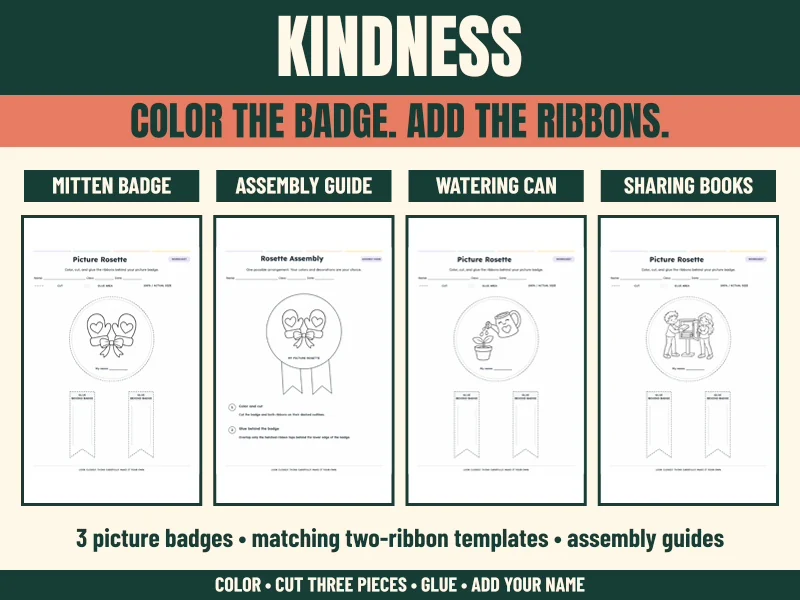
- One 8-page printable PDF
- Three picture rosette designs with circular centres, ribbon tails and assembly guidance
How it works. Colour a picture, cut out the circle and tails, then glue the pieces together to make a paper rosette for a classroom kindness activity.
Use the finished rosette as a prompt to discuss one specific act of kindness. Avoid turning the task into a competition to label one child the kindest.
Stand Up Character and Diorama Craft
A stand-up figure and backdrop create a small scene for oral storytelling.
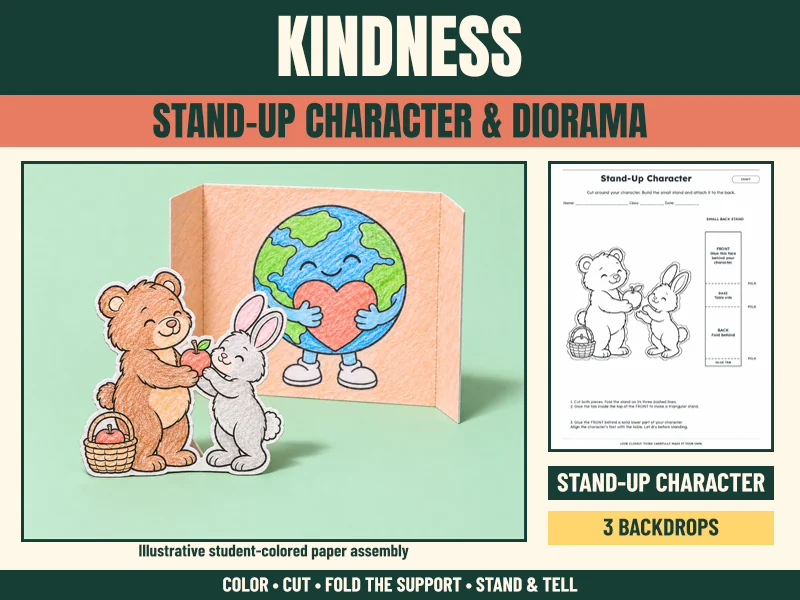
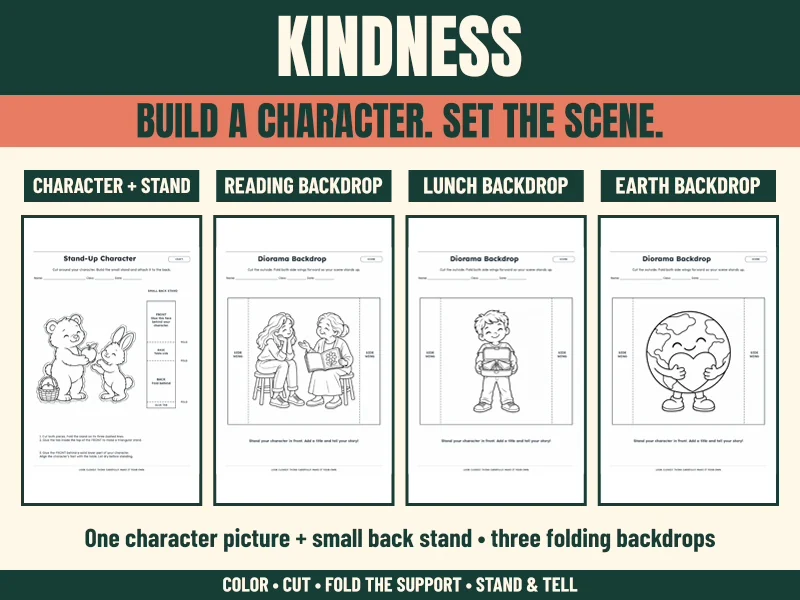
- One 6-page printable PDF
- Four picture templates arranged as a stand-up character activity and diorama backdrops
How it works. Colour and cut the stand-up character, fold and glue its base strip, then add it to a backdrop to create a small storytelling scene.
Place the character in the scene and ask what happened just before this moment. Move the figure and tell what could happen next.
Colour Cut and Glue Activities
This resource combines colouring, cutting practice and reconstructing a picture on a guide.
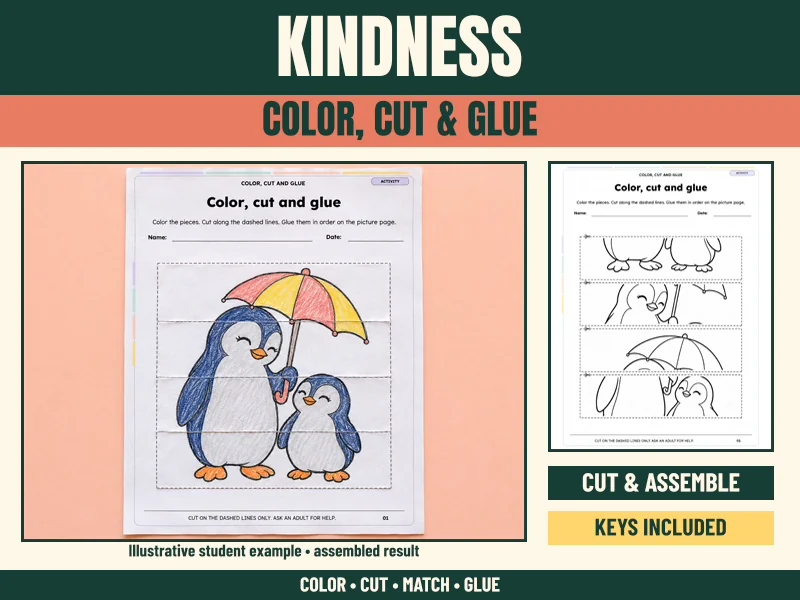
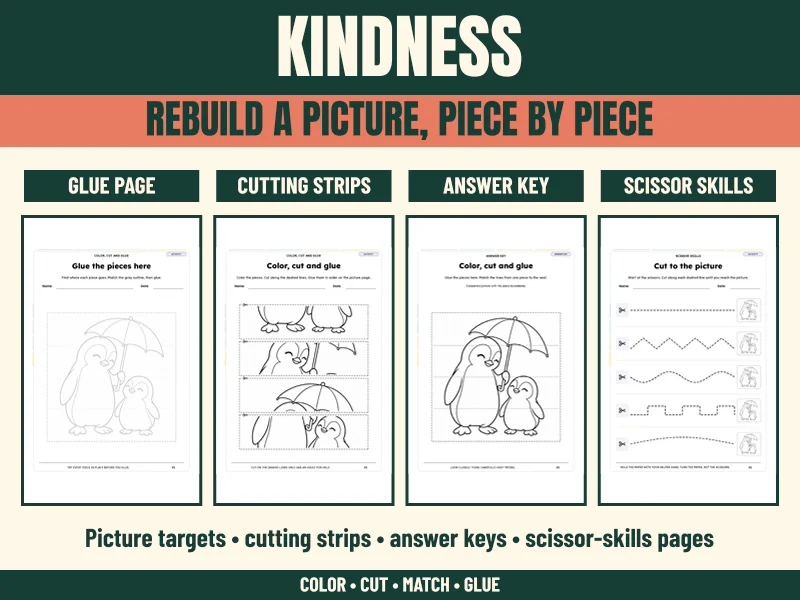
- One 22-page printable PDF
- Five picture sets with a gluing guide, mixed strips, completed reference picture and scissor-practice page
How it works. Colour the picture pieces, practise cutting, arrange the strips and glue them onto the matching guide. Compare the assembled picture with its reference.
Before gluing, ask partners to check one line that crosses between two strips. Keep the reference nearby so the decision rests on a visible clue.
Art & drawing
Drawing activities ask children to look in different ways. A step-by-step guide builds a picture in stages; a grid helps transfer one small area at a time; symmetry asks for a reflection. Choose the process you want to model, then let the preview show you how much detail is involved.
Directed Drawing Worksheets
Step-by-step picture stages give learners a sequence for building a drawing.
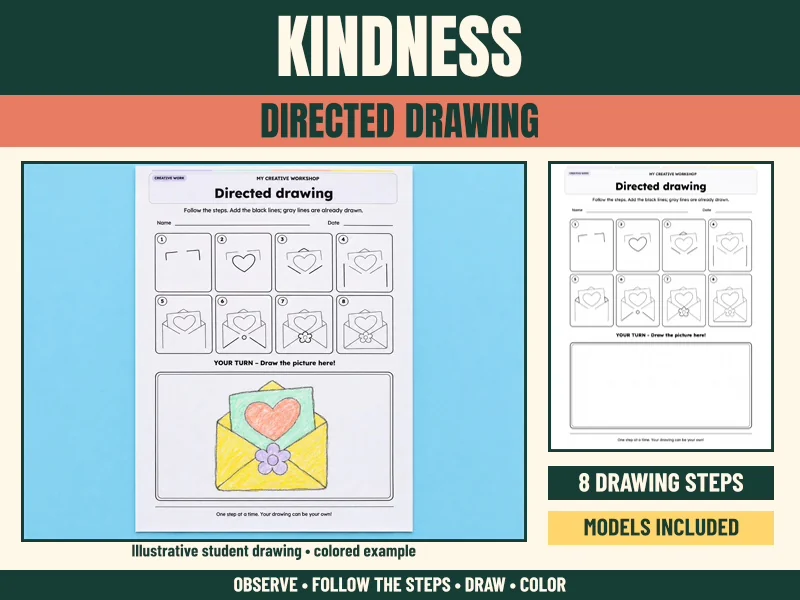
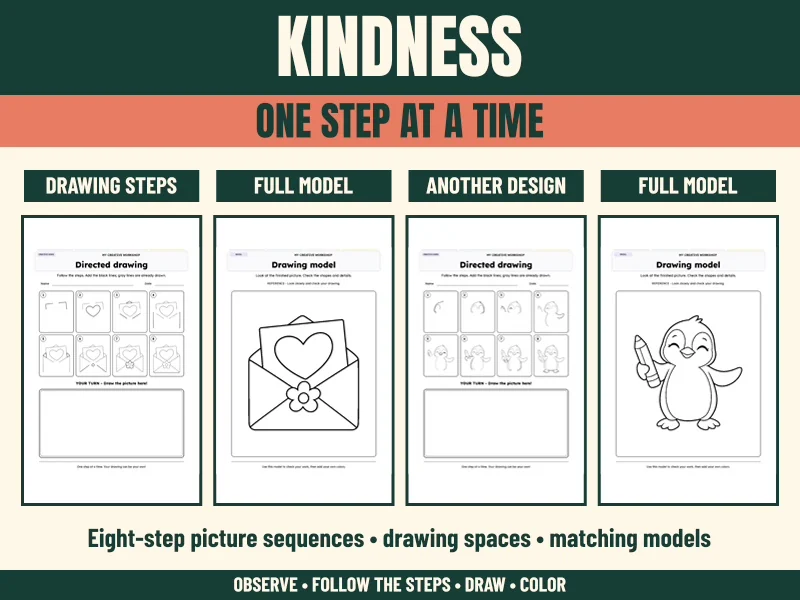
- One 14-page printable PDF
- Six drawing sets with step-by-step picture guides, drawing spaces and finished models
How it works. Follow the drawing stages in order, build the picture from its simple shapes and use the finished model to check details. Add colour and describe the helpful action shown.
Model one stage, then pause so children can compare the shapes they have drawn. Finish by naming the helpful action shown instead of comparing artistic ability.
Complete the Picture Drawing Worksheets
Partly finished pictures leave a specific drawing problem for the learner to solve.
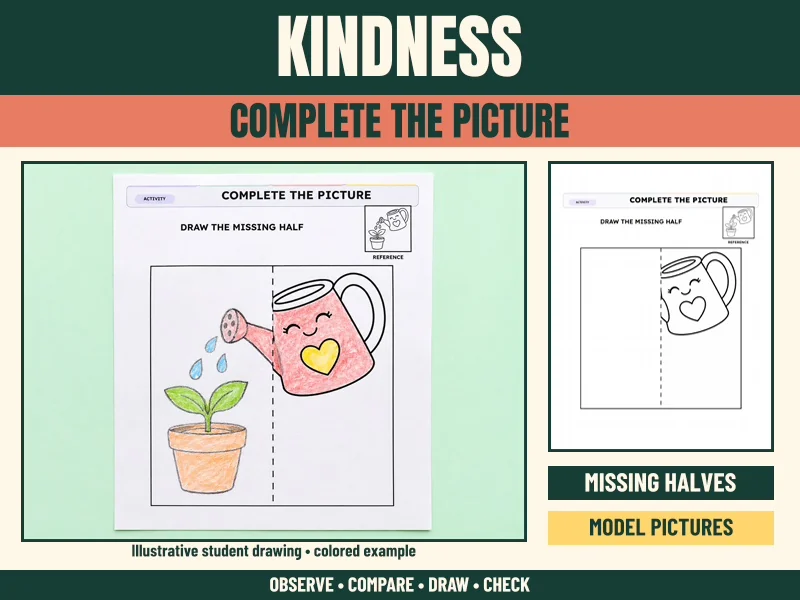
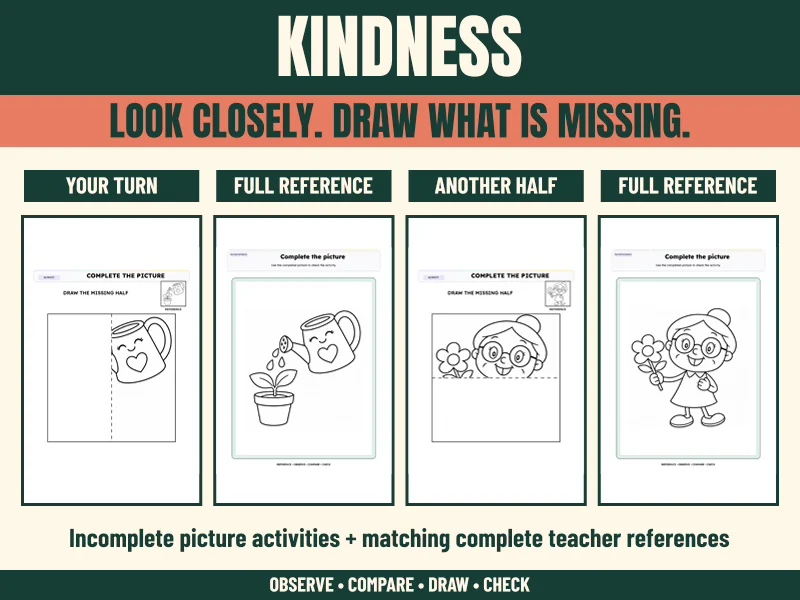
- One 14-page printable PDF
- Six partially completed picture worksheets and six finished reference pictures
How it works. Study a reference, notice the missing lines, then complete the matching picture. Invite learners to describe the kind actions they can see.
Compare the model and the incomplete page. Ask children to point to one missing detail before drawing it, then explain how it changes the picture.
Grid Drawing Activities
Matching grids break a full drawing into smaller areas to copy.
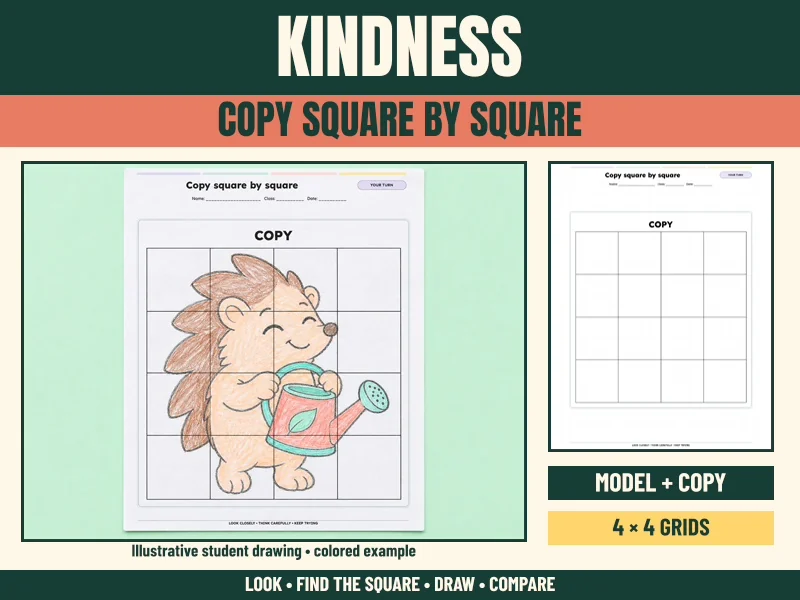
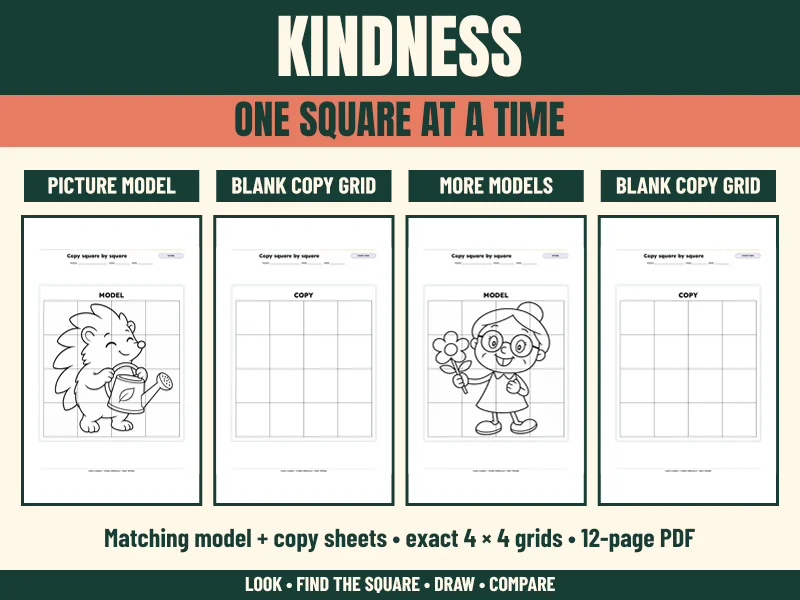
- One 12-page printable PDF
- Five drawing models and five matching blank grids
How it works. Look at one square at a time and copy the lines into the corresponding square on the empty grid. Build the full picture gradually and add colour.
Cover the rest of the model with scrap paper and copy one square. Move the paper to reveal the neighbouring square and check where the lines meet.
Grid Coordinates Drawing Worksheets
Lettered columns and numbered rows help learners locate corresponding drawing squares.
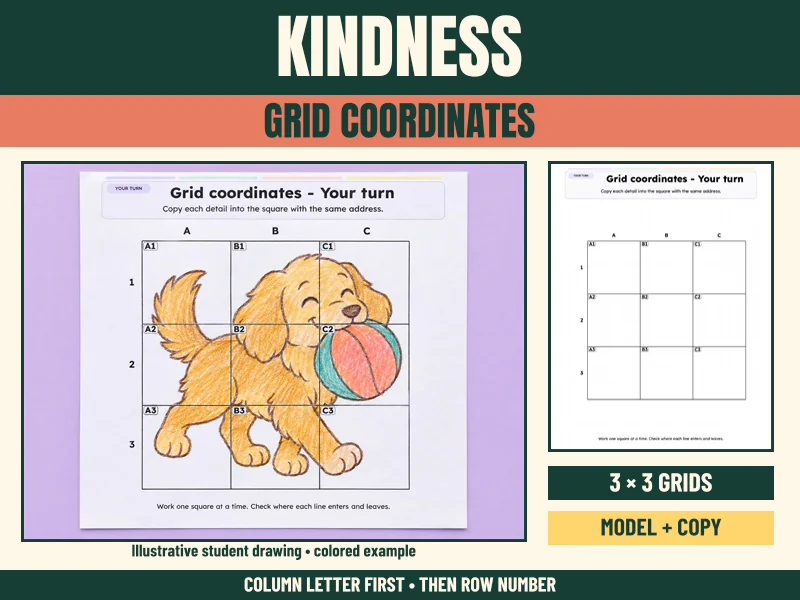
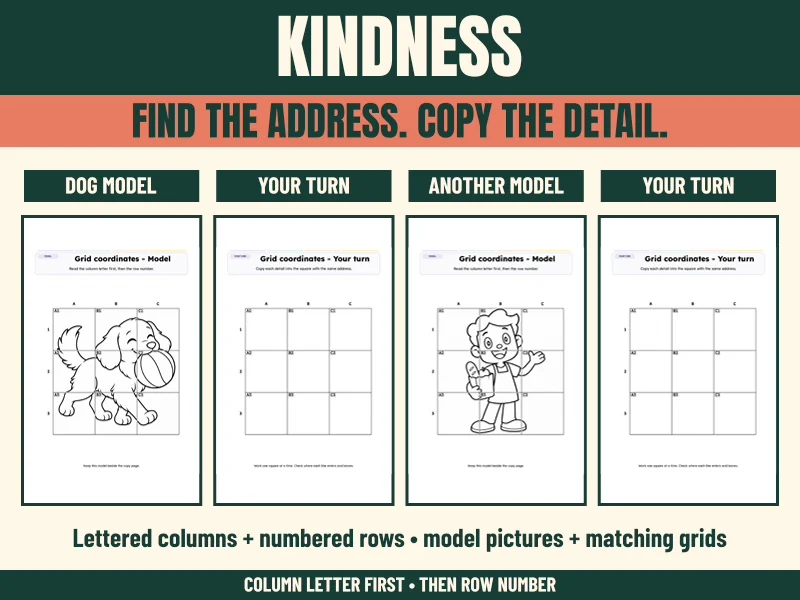
- One 10-page printable PDF
- Four picture models and four matching coordinate drawing grids
How it works. Read the lettered columns and numbered rows, find the matching square and copy its lines onto the empty grid.
Practise naming a coordinate on a simple teacher-drawn grid. Then have one partner name a square while the other finds it on the printed model.
Pixel Art Grid Drawing Worksheets
Dark and light squares build a picture row by row.
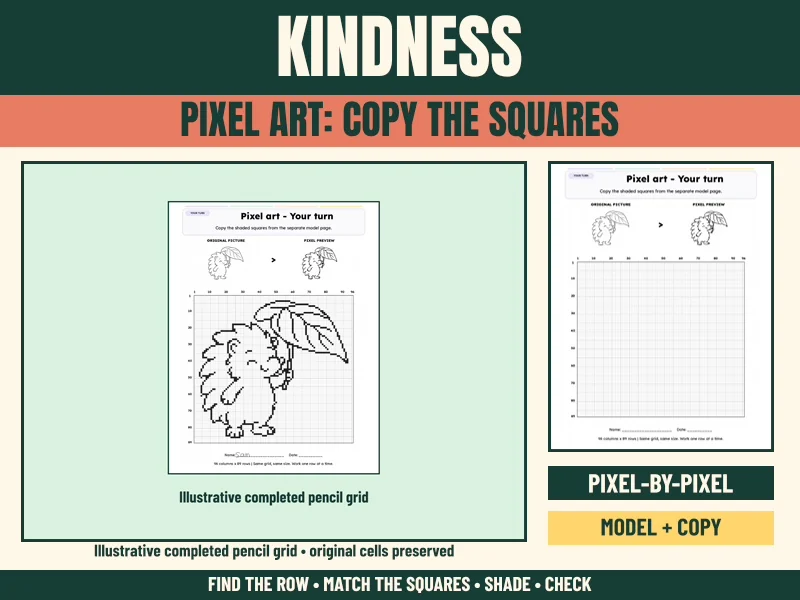
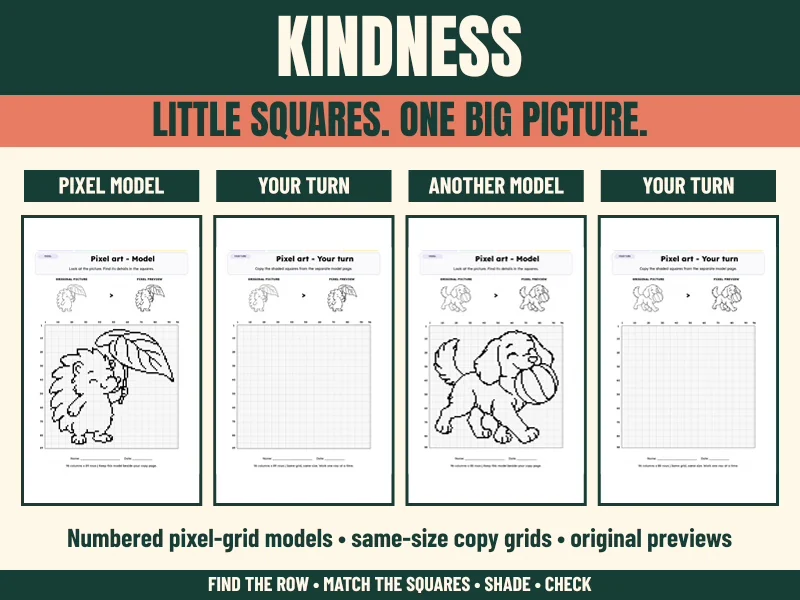
- One 12-page printable PDF
- Five pixel-picture models and five matching blank grids
How it works. Copy the dark and light squares from each model onto the corresponding grid, working row by row to build the picture.
Use a ruler or scrap strip to keep track of the current row. Count the empty squares as carefully as the shaded ones and compare one completed row before continuing.
Symmetry Drawing Worksheets
The vertical mirror line gives every copied mark a matching distance to maintain.
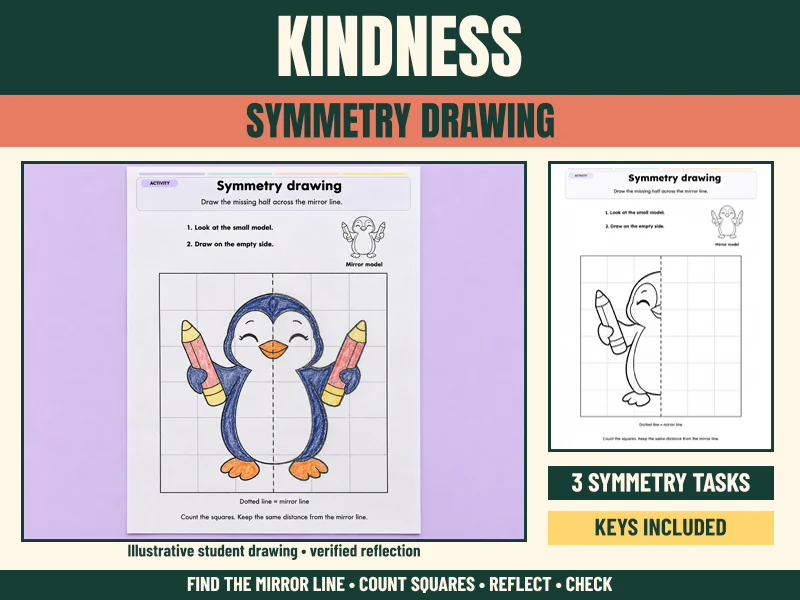
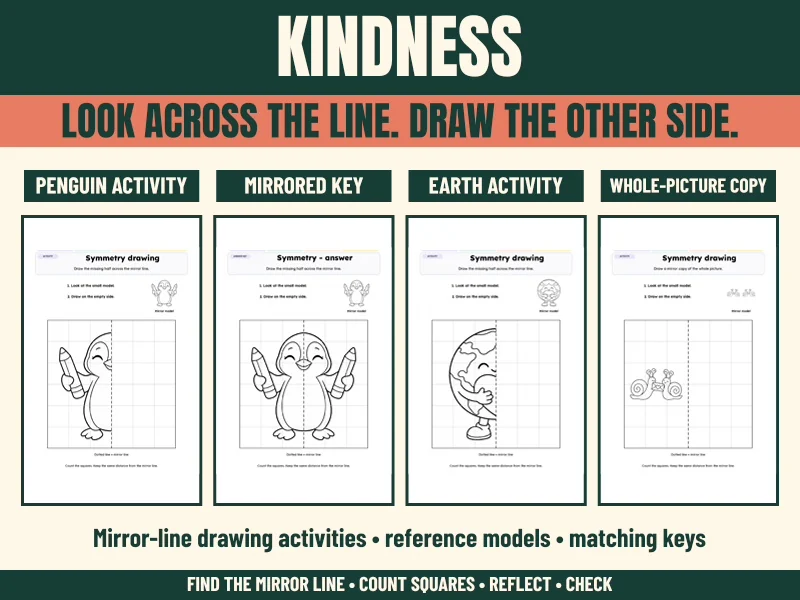
- One 8-page printable PDF
- Three half-picture symmetry worksheets and three completed reference answers
How it works. Identify the vertical mirror line and draw the missing half on the empty side of the grid, checking each detail at the same distance from the line.
Start with one point close to the line. Count its distance, place the reflected point, and repeat before joining lines to form the missing half.
Puzzles & games
Picture puzzles work best when children can explain a choice as well as make it. Some tasks involve rebuilding a whole image, while others ask learners to compare a small missing section or a silhouette. Match the format to the amount of cutting, handling and visual comparison your group is ready for.
Memory Card Game
Six pairs make a compact turn-taking memory game.
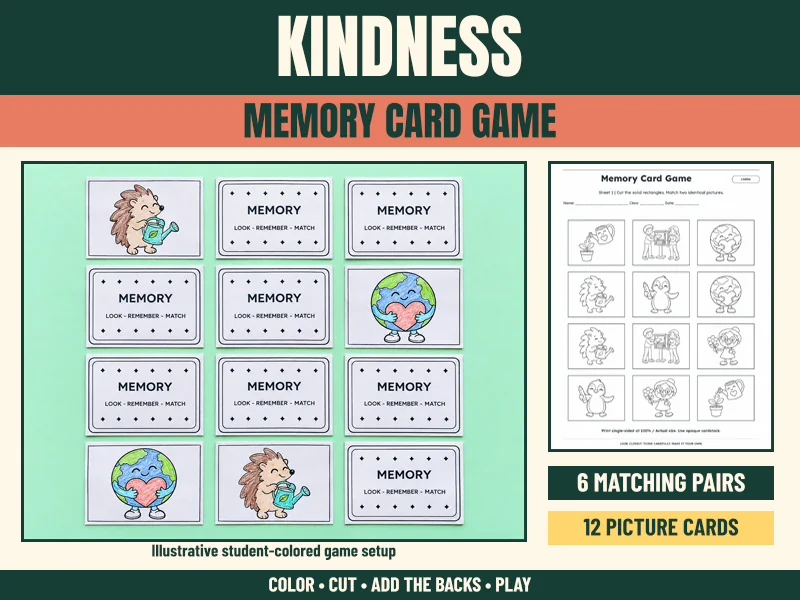
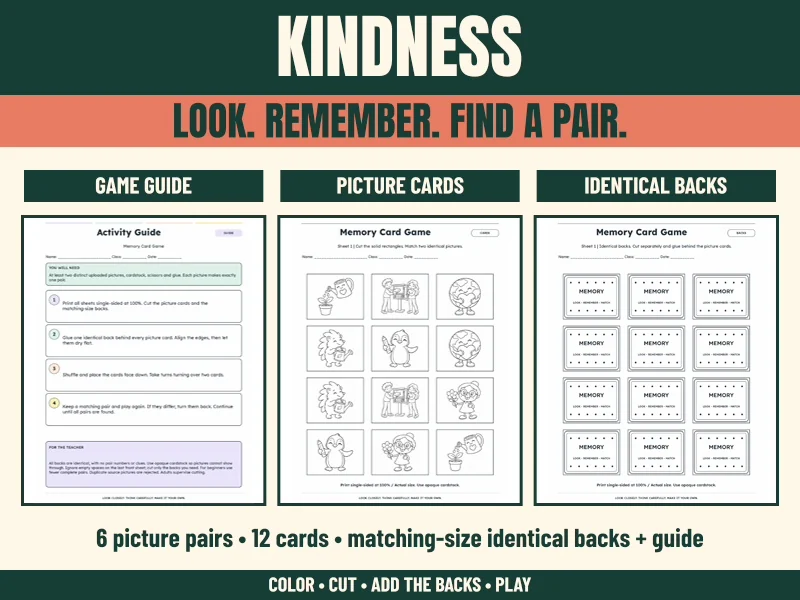
- One 4-page printable PDF
- 12 picture cards forming six matching pairs, a printable card-back sheet and activity instructions
How it works. Print and cut the cards, place them face down and take turns turning over two cards to find a matching pair. Use the pictures to start a kindness conversation.
Begin with three pairs while partners learn the rules, then use the full set. When a pair is found, describe one helpful action suggested by the picture.
Printable Jigsaw Picture Puzzles
Nine interlocking pieces make each jigsaw a contained reconstruction task.
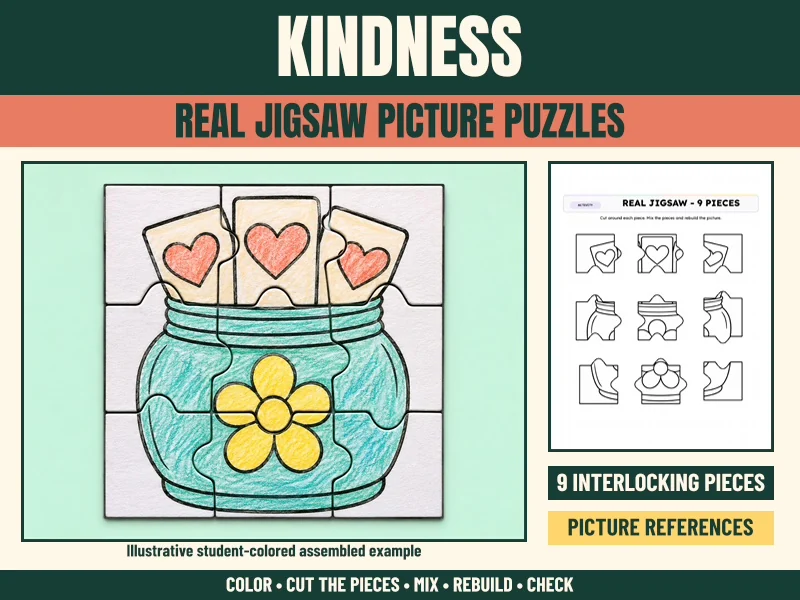
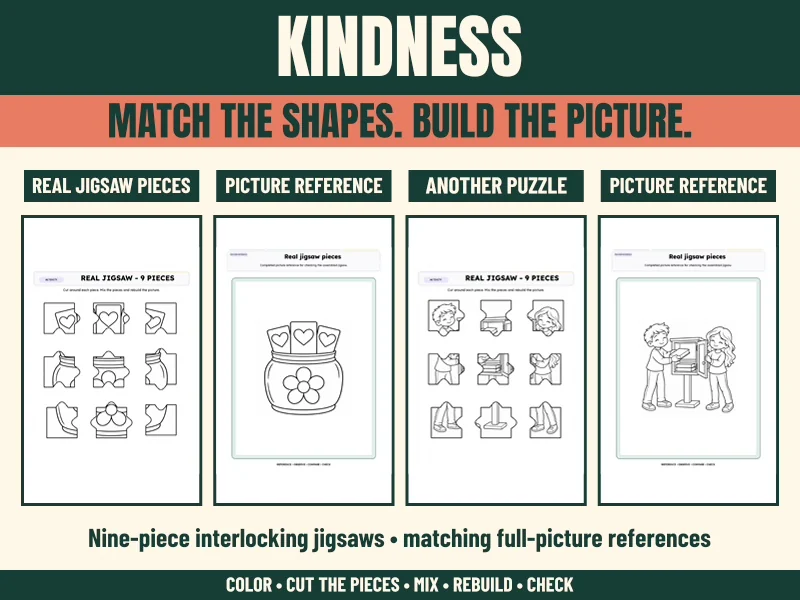
- One 14-page printable PDF
- Six nine-piece jigsaw picture puzzles and six completed picture references
How it works. Cut out the interlocking pieces, mix them and use the edge shapes and picture details to rebuild each image.
Sort obvious edge pieces and look for a distinctive picture detail. Give partners alternating turns to place a piece and explain the clue they used.
Vertical Strip Picture Puzzles
Vertical strips emphasise left-to-right picture reconstruction.
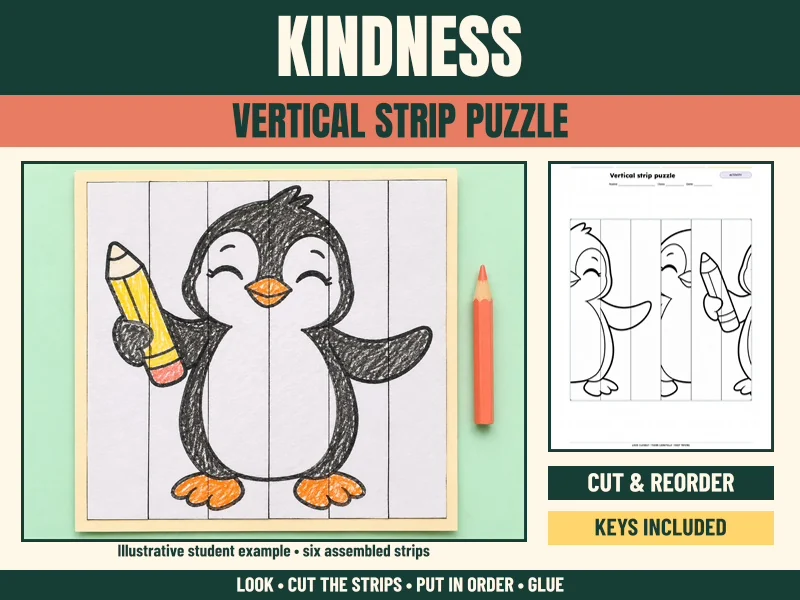
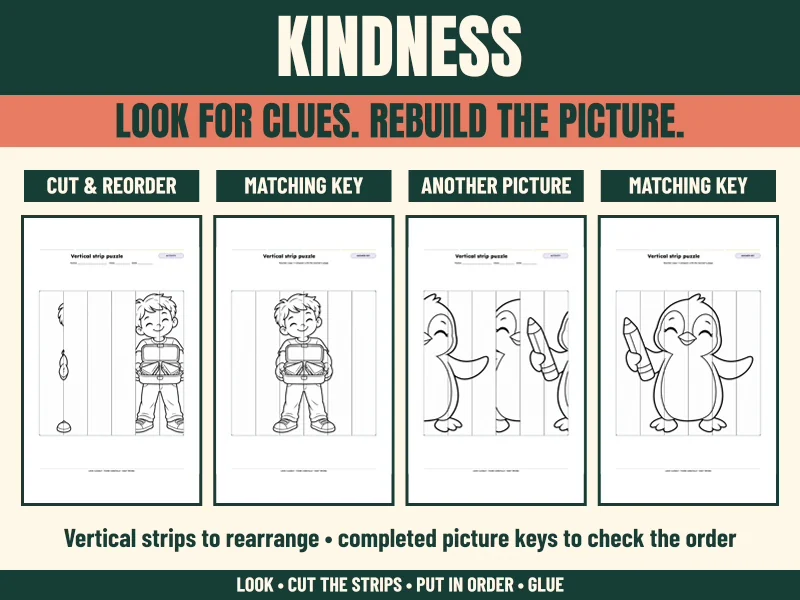
- One 12-page printable PDF
- Five mixed vertical-strip picture puzzles and five completed references
How it works. Colour the pictures, cut along the vertical lines and arrange the strips so that the details match before gluing them down.
Locate an obvious outer edge and match the next strip using a line that crosses the join. Keep the strips loose until the whole picture has been checked.
Horizontal Strip Picture Puzzles
Horizontal strips make top-to-bottom order the main reconstruction challenge.
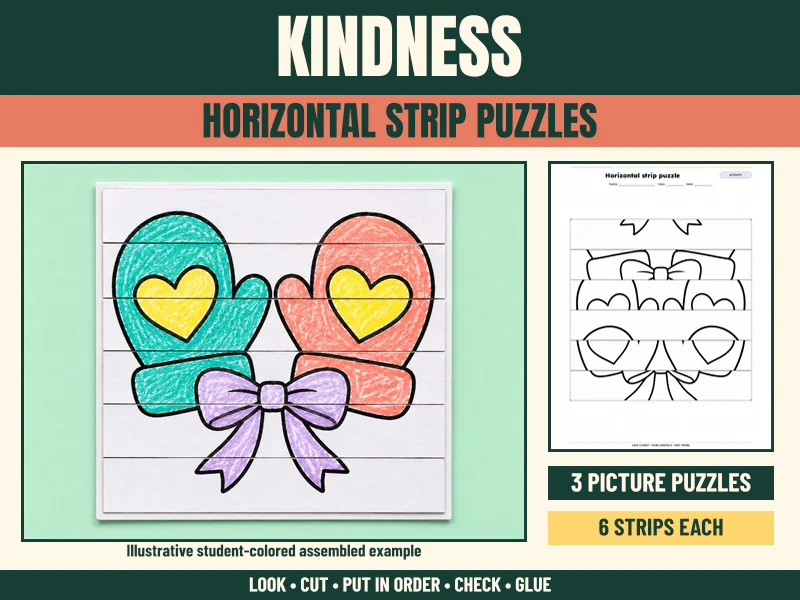
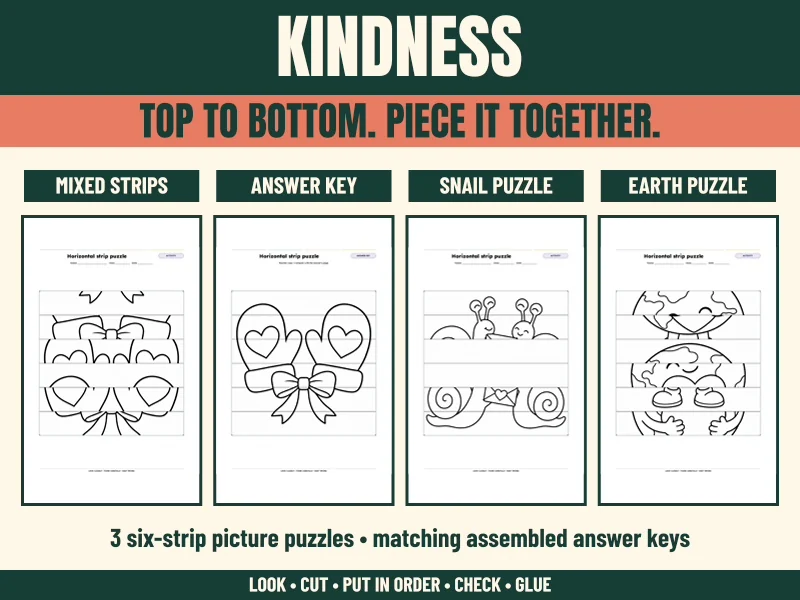
- One 8-page printable PDF
- Three mixed horizontal-strip puzzles and three completed picture references
How it works. Colour and cut the strips, compare the picture details, arrange the strips in order and glue the reconstructed image onto paper.
Find two strips with a line that continues across their edges. Explain the match before placing the next strip; check the whole image before gluing.
Missing Piece Picture Puzzles
A single missing square encourages close comparison of a small area.
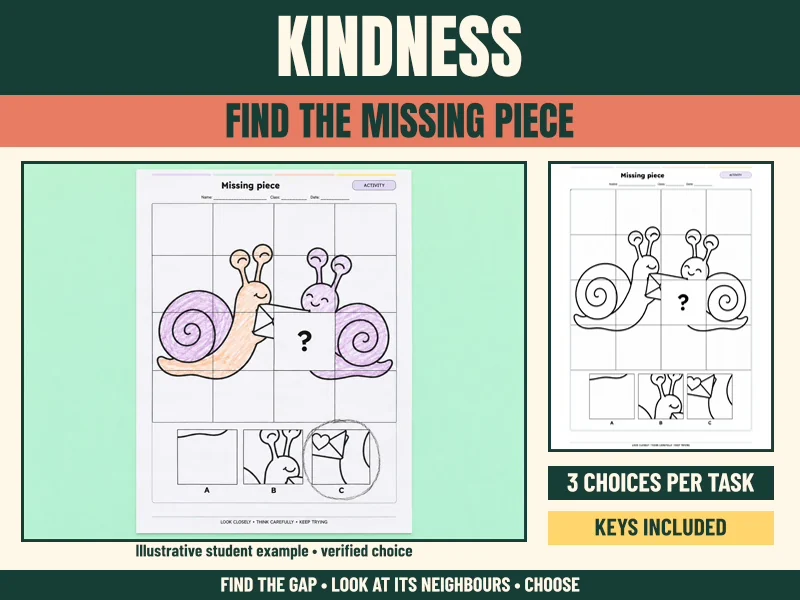
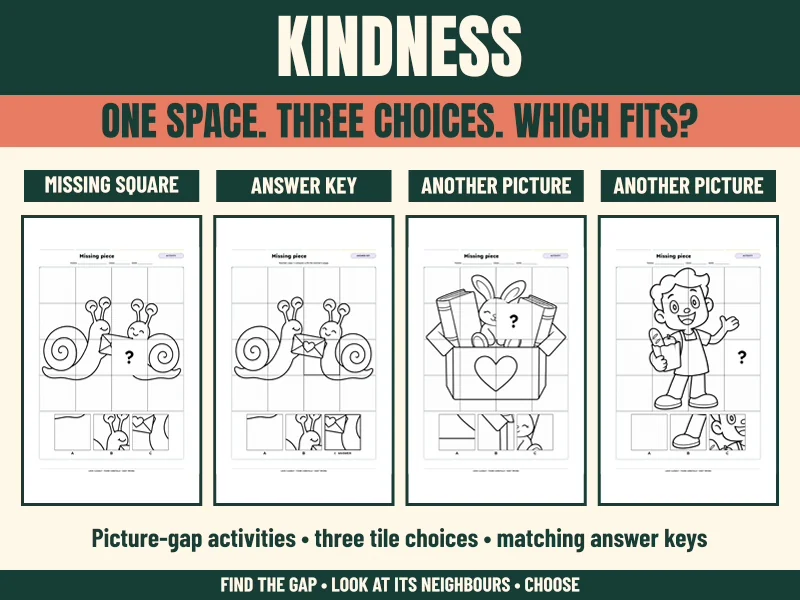
- One 10-page printable PDF
- Four missing-square picture puzzles with multiple-choice pieces and four completed references
How it works. Identify the empty square, compare the offered pieces and choose the piece whose lines complete the picture.
Before choosing, describe where a line enters the empty square. Compare that clue with each offered piece and explain why a near match does not fit.
Multiple Missing Pieces Picture Puzzles
Several missing squares add a placement decision as well as a matching decision.
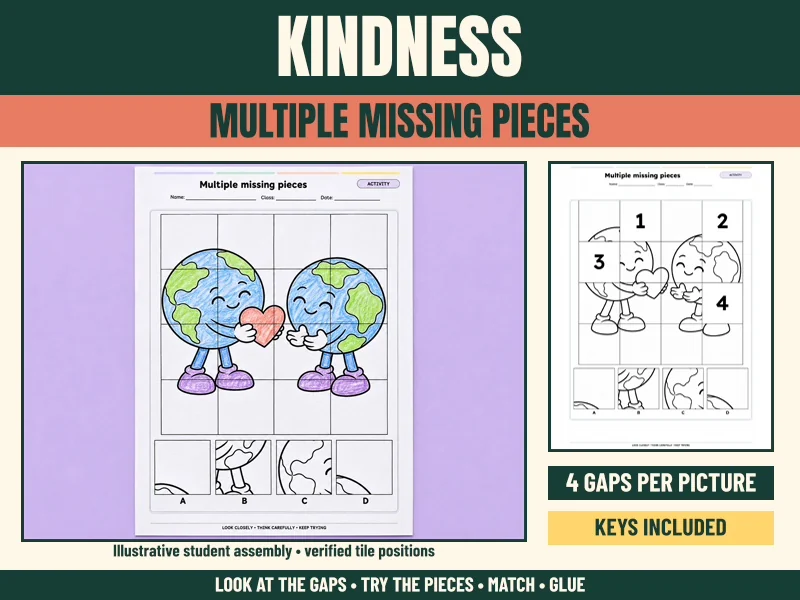
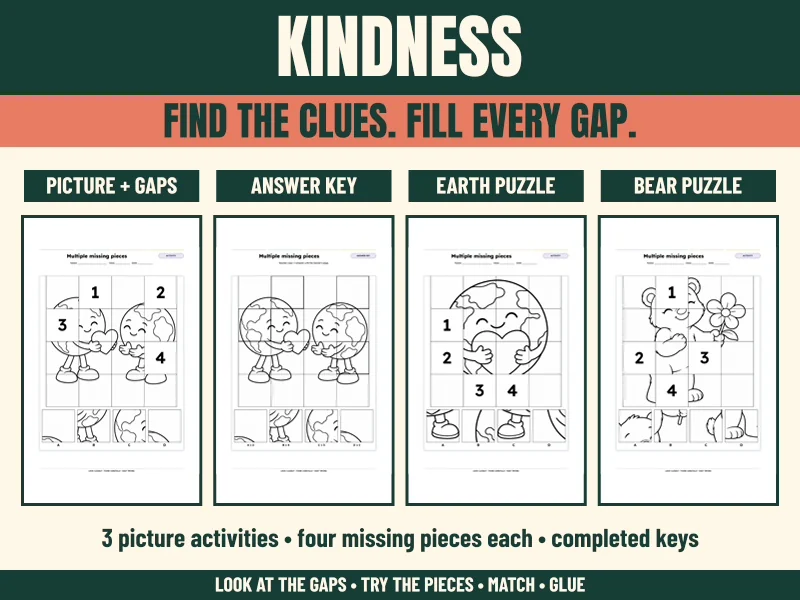
- One 8-page printable PDF
- Three picture puzzles with several numbered missing squares, choice pieces and completed references
How it works. Match each missing section to its correct space, using the picture lines and neighbouring details to check the arrangement.
Match the most distinctive piece first, then use its neighbouring lines to check another gap. Describe the evidence for each placement before gluing.
Mixed Grid Picture Puzzles
Mixed grid squares require learners to rebuild the image from local details.
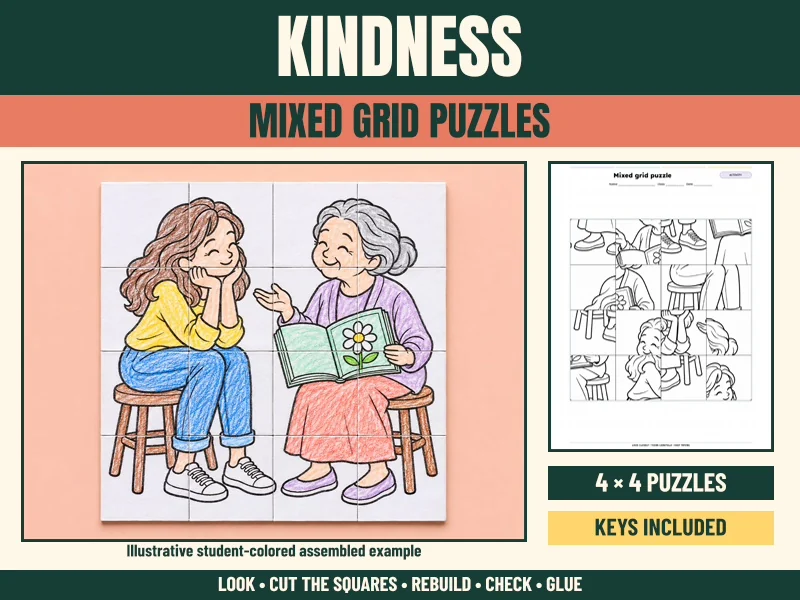
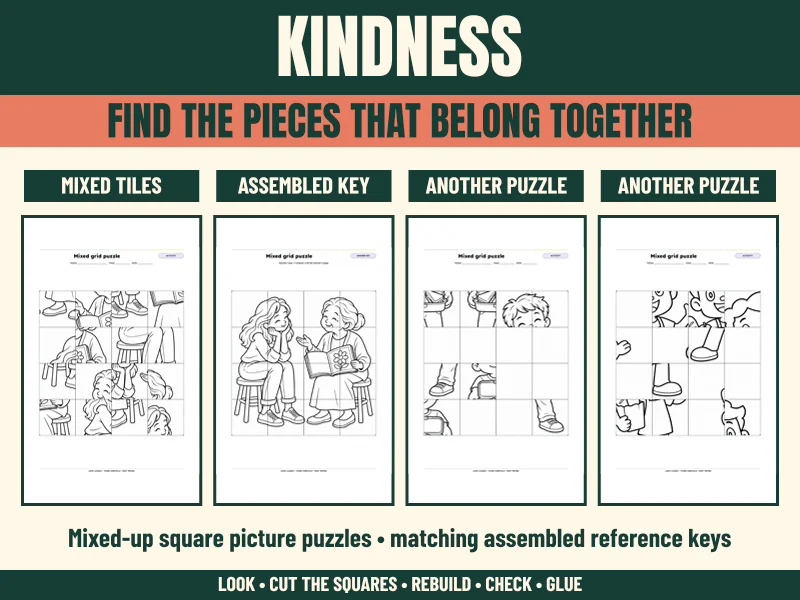
- One 12-page printable PDF
- Five mixed-square picture puzzles and five completed picture references
How it works. Study the picture edges, cut out the grid pieces, rotate and rearrange them, then glue the completed picture onto paper.
Start with a distinctive corner or edge. Ask partners to agree on the orientation of a piece before fitting the next square beside it.
Match Identical Pictures Worksheets
Different matching formats ask learners to compare the same pictures in more than one way.
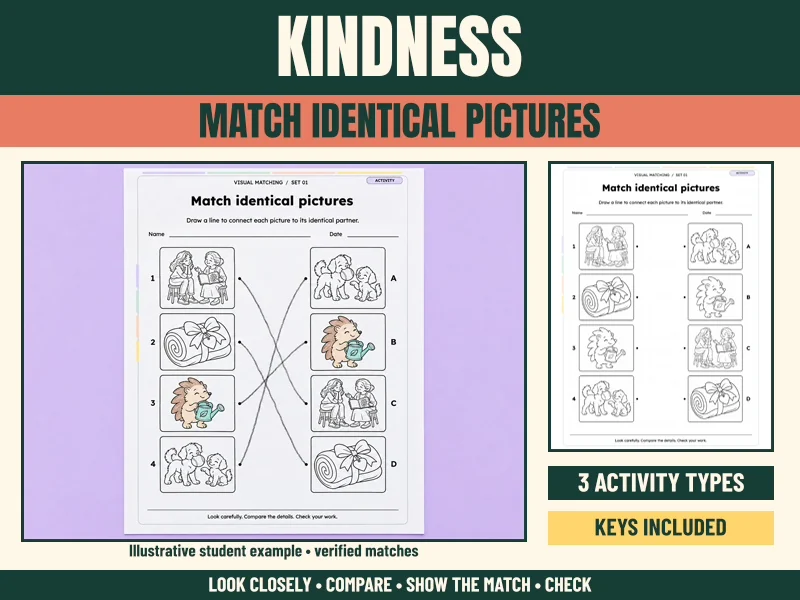
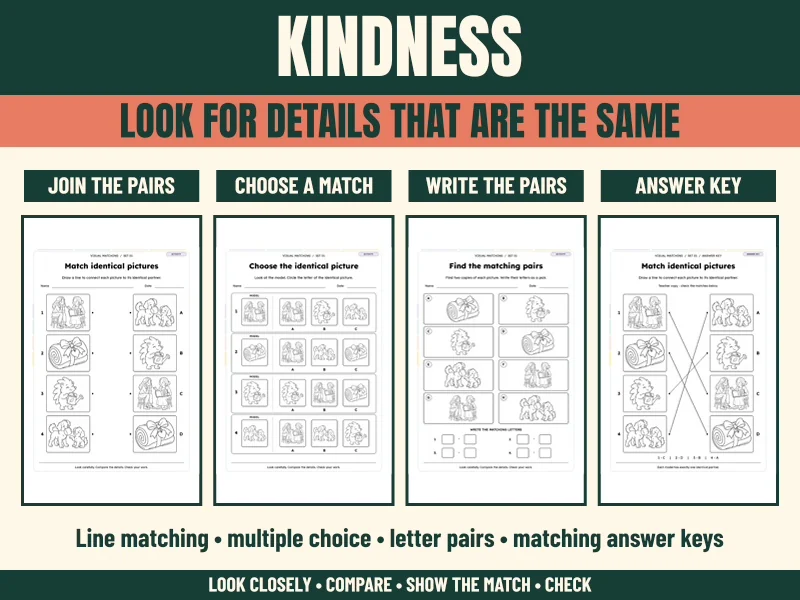
- One 8-page printable PDF
- Picture matching activities in connect-the-pairs, choose-the-identical-picture and find-the-pairs formats
How it works. Look closely at the details, compare the pictures and record matching pairs using the directions on each worksheet.
Choose a pair and name two features that are identical. For a distractor, point to the feature that prevents a match.
Picture and Shadow Matching Worksheets
Shadow matching focuses attention on the outline rather than interior details.
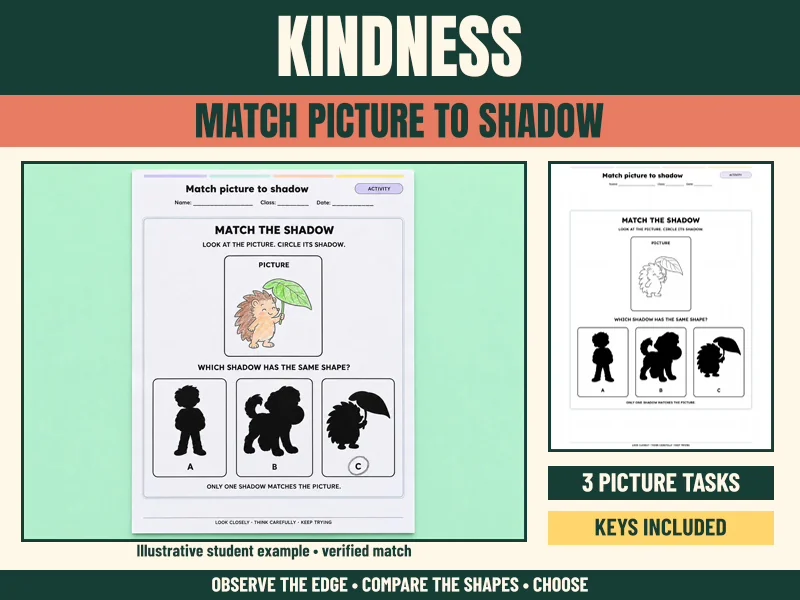
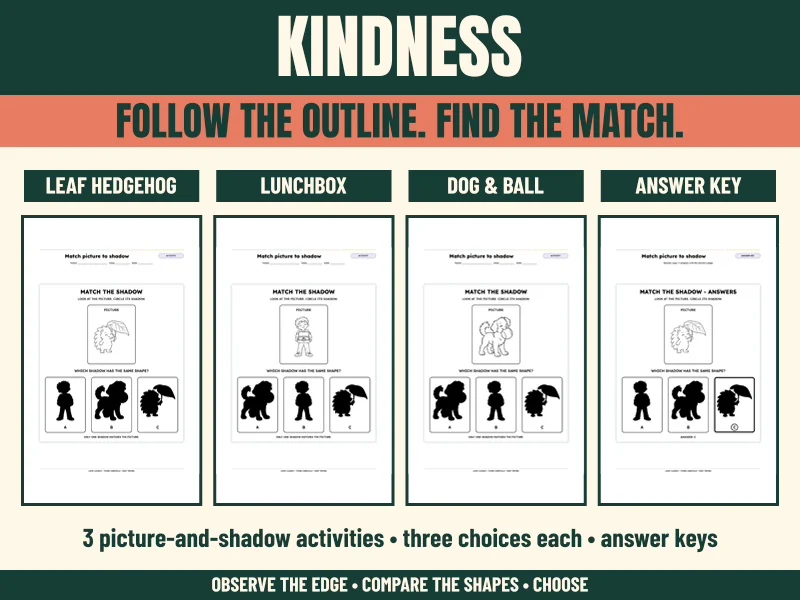
- One 8-page printable PDF
- Three picture-to-shadow worksheets and three answer pages
How it works. Study the picture, compare the three silhouettes and select the matching outline. Explain the features that helped you choose.
Ask learners to describe the silhouette before choosing. A useful explanation might refer to an arm position or a shape at the edge.
Picture Mazes
The mazes combine route finding with a kindness-themed picture.
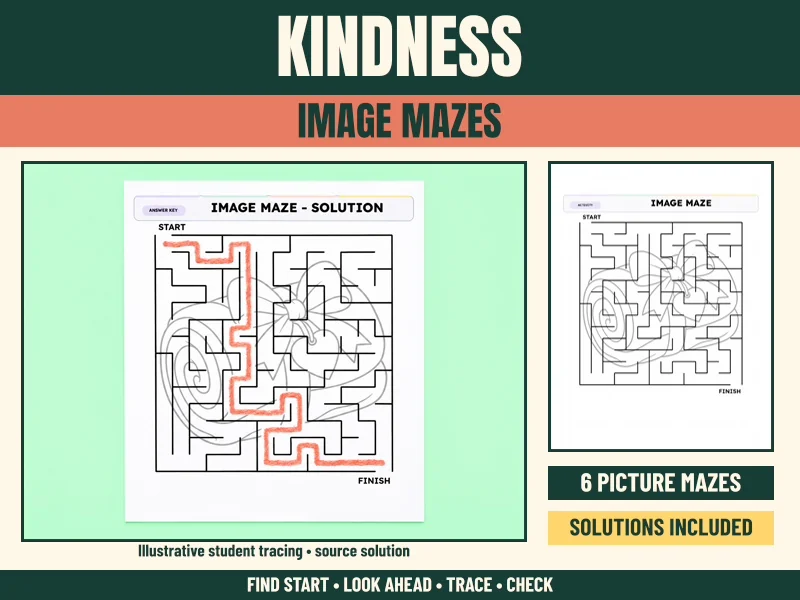
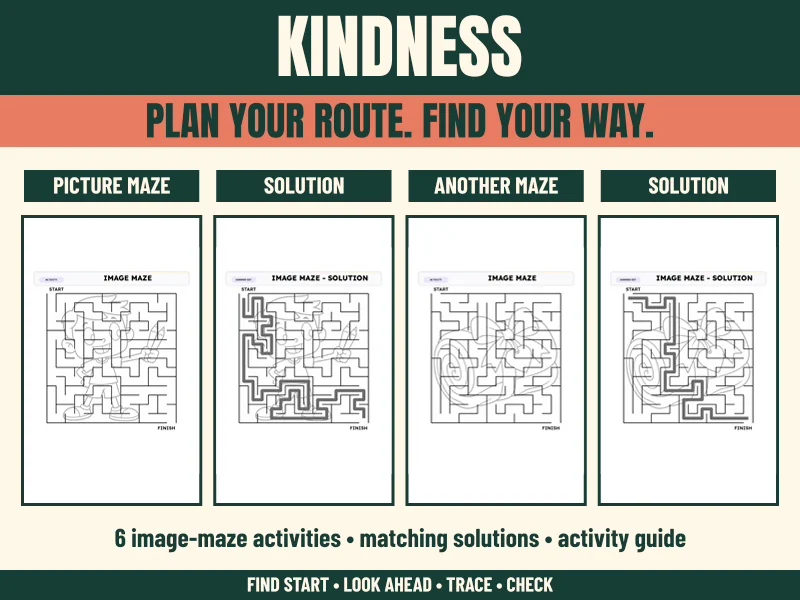
- One 14-page printable PDF
- Six kindness-themed picture mazes and six solution pages
How it works. Trace a continuous route from start to finish, avoid the blocked paths and compare with the solution. Colour the picture after solving the maze.
Trace the route with a finger before marking it. Ask a partner to describe where a blocked path made them change direction, then check the solution.
Tracing & fine motor
A tracing sheet, a dot-marker picture and a lacing card offer different ways to handle materials and follow a visual path. Choose a task that is comfortable for the learner, demonstrate the first move and allow a short, focused practice rather than rushing through every page.
Alphabet Handwriting Worksheets
Uppercase letter models lead into independent practice on ruled lines.
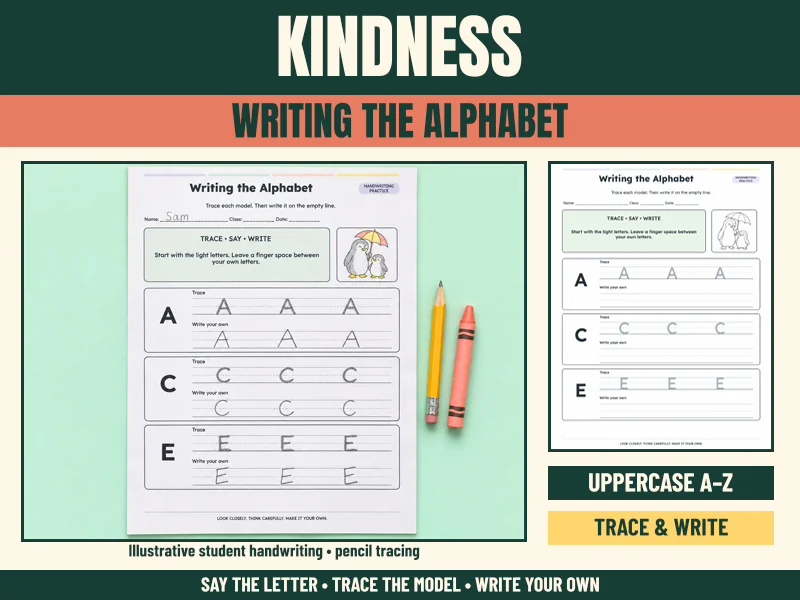
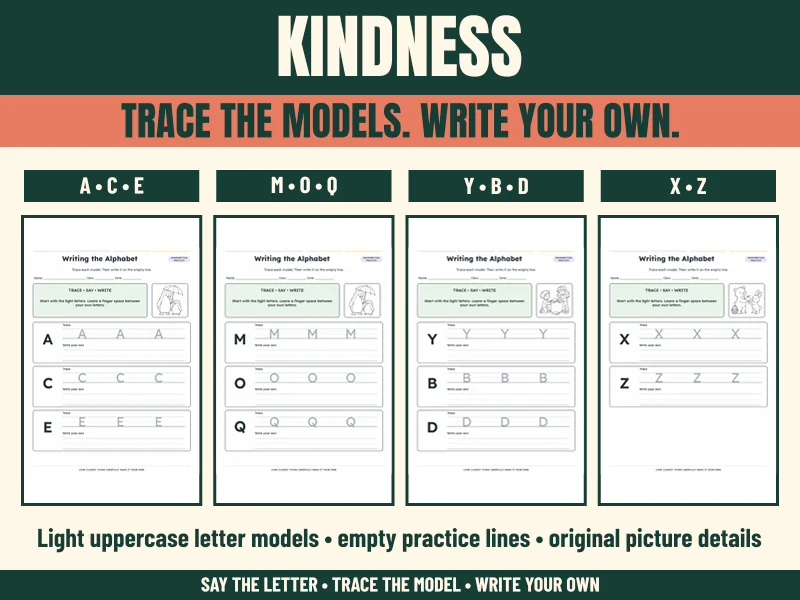
- One 11-page printable PDF
- Uppercase alphabet tracing and independent writing practice across three picture-themed groups of pages
How it works. Say each letter name, trace the large letter models and practise writing independently on the ruled lines. Use the picture decorations as a starting point for kindness vocabulary.
Choose a small set of letters, trace each model and make one independent attempt. Then find a starting letter for a kindness word you discuss together.
Trace the Picture Worksheets
Pale continuous lines guide a complete picture trace.
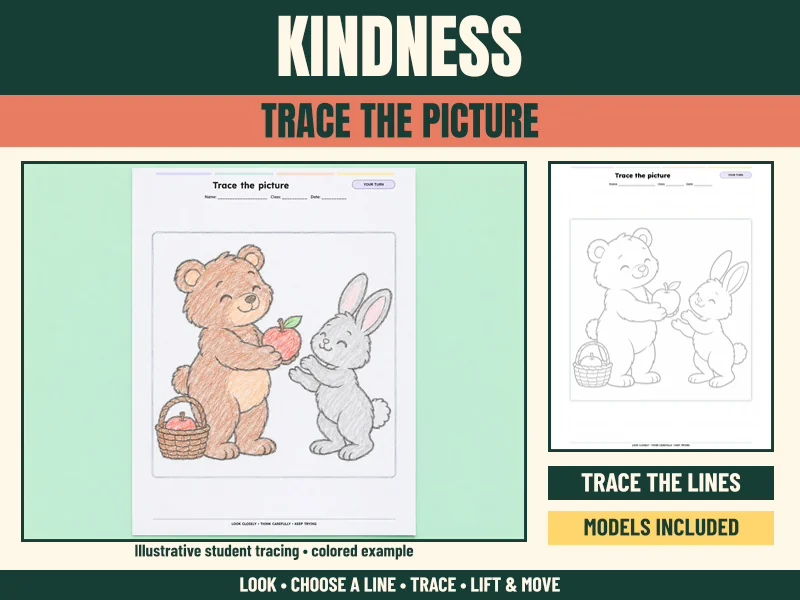
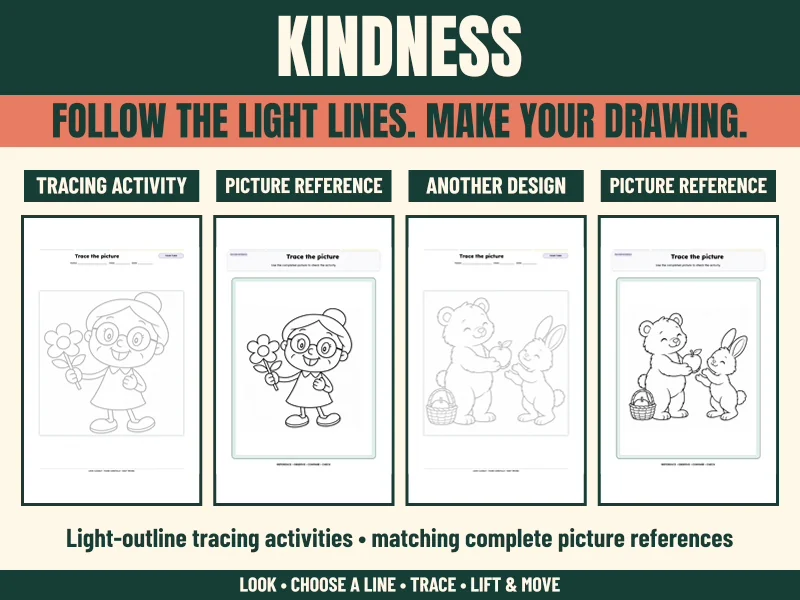
- One 10-page printable PDF
- Four light-line tracing pictures and four finished picture references
How it works. Follow the pale outlines with a pencil, compare your work with the model and colour the finished kindness-themed picture.
Follow a short section slowly, lift the pencil at a natural break and find the next starting point. Use the completed reference to check missing details.
Dotted Outline Tracing Worksheets
Small dotted outlines provide a different tracing cue from continuous pale lines.
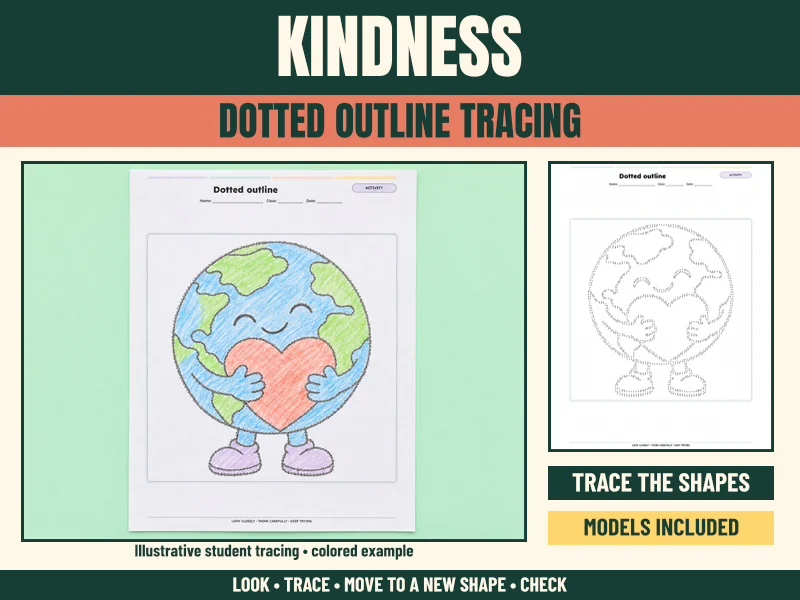
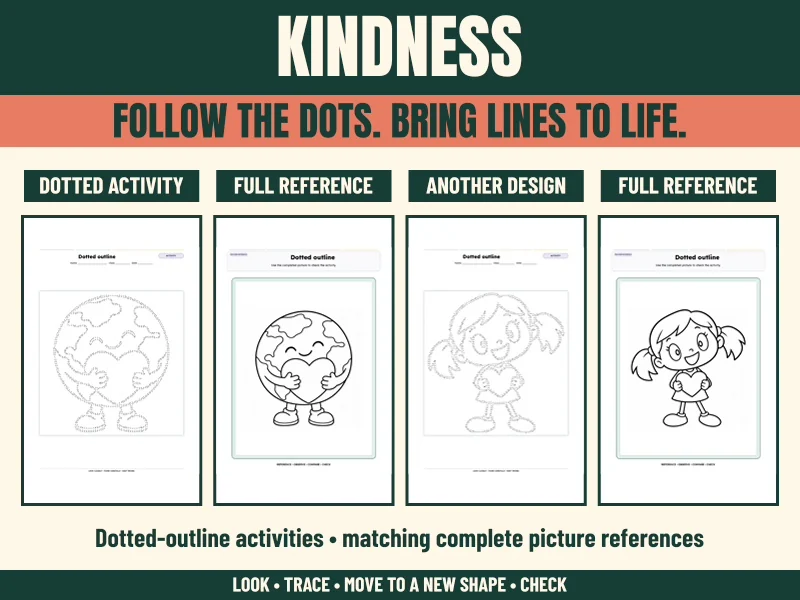
- One 10-page printable PDF
- Four dotted-outline pictures with four completed picture references
How it works. Follow the small dots to trace the outline, check against the finished model and colour the completed picture.
Trace a short part with a finger first, then follow the same route with a pencil. Compare the completed outline with the reference before adding colour.
Dot Marker Craft Worksheets
The circles give dot marks a clear target within a picture.
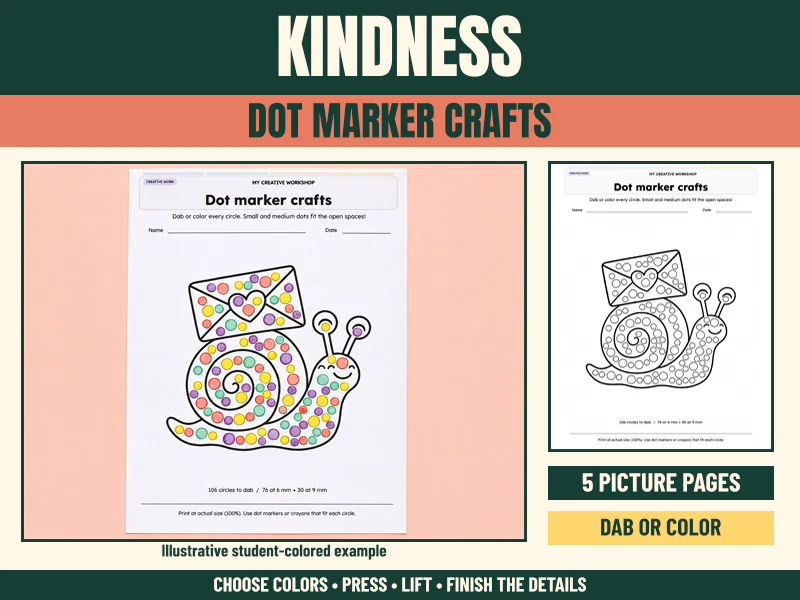
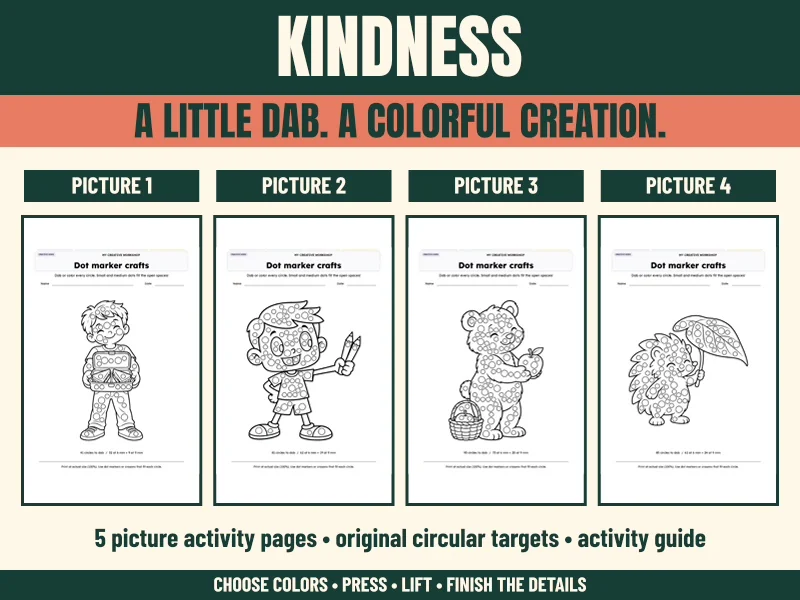
- One 7-page printable PDF
- Five kindness-themed dot-marker picture pages and an activity guide
How it works. Fill the circles with dot markers, finger dots or small coloured marks. Invite children to name the characters and talk about helpful actions.
Choose two colours and decide where each will go before beginning. After completing the marks, ask the learner to describe a character in the illustration.
Lacing Cards
Lacing adds threading and following an edge to a picture activity.
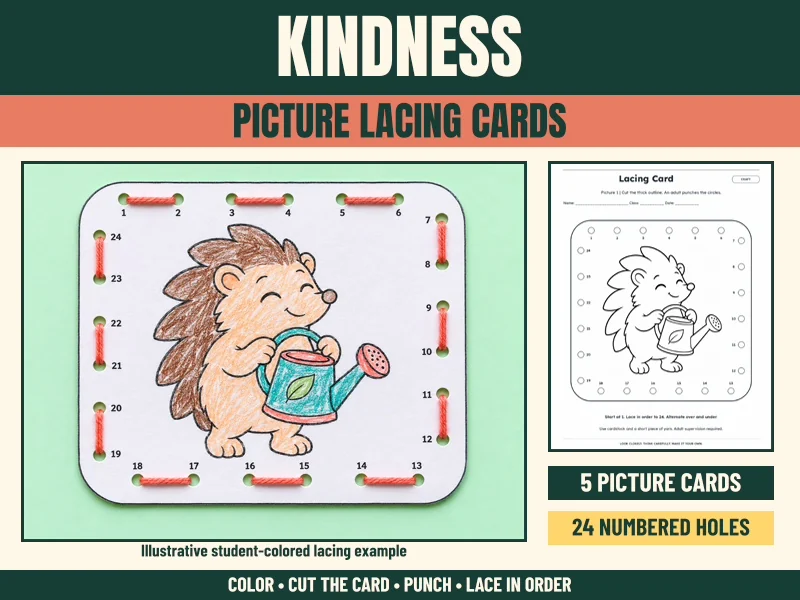
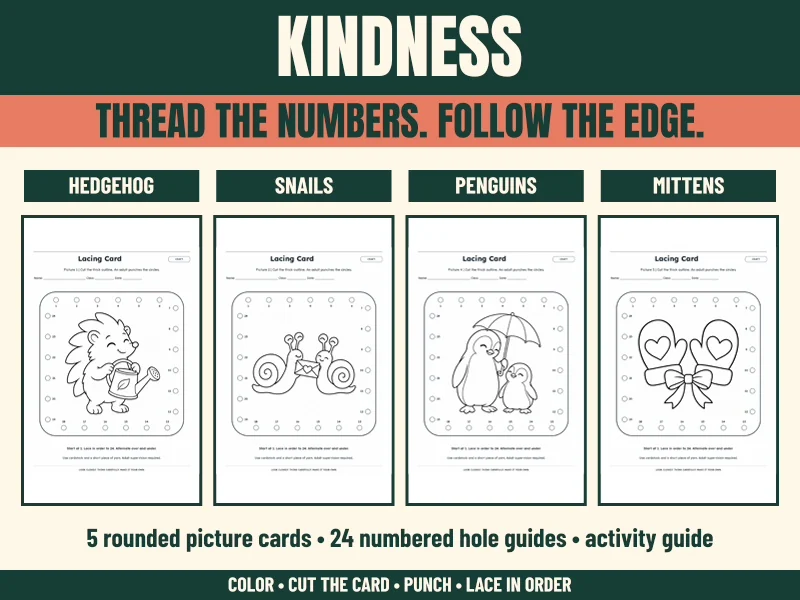
- One 7-page printable PDF
- Five kindness-themed lacing-card templates and an activity guide
How it works. Colour the picture, mount or print it on card, cut it out and punch the marked holes. Thread a lace through the holes around the edge.
After adult help with preparing holes as needed, practise entering one hole and moving to the next. Pause to describe the direction around the card.
Connect the Dots Worksheets
Numbered dots give the drawing a sequence to follow.
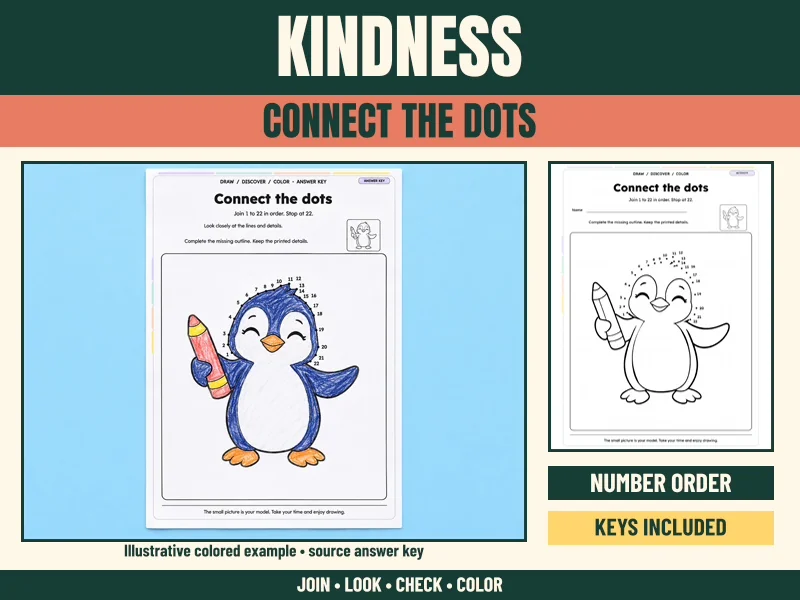
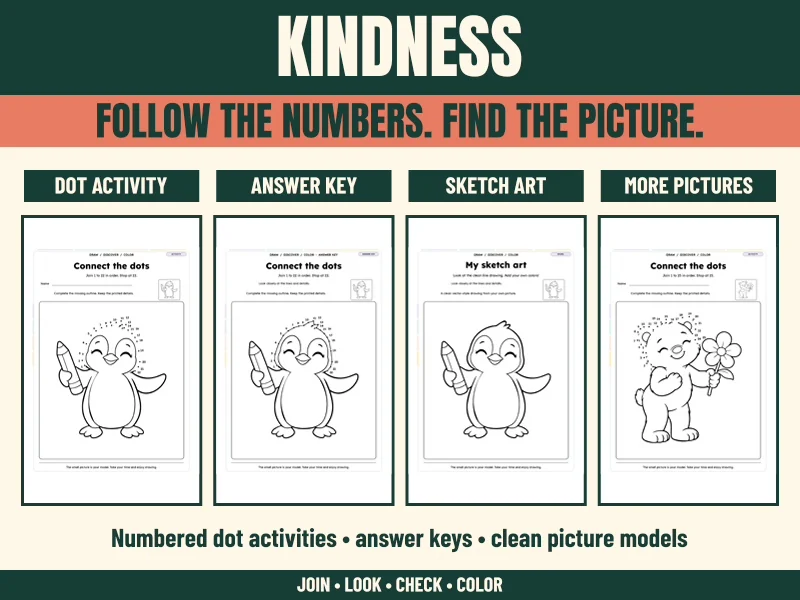
- One 14-page printable PDF
- Four picture sets with dot-to-dot worksheets, answer pictures and clean drawing models
How it works. Follow the numbered dots to reveal each kindness-themed picture, check the model and add colour.
Pause partway through and ask which number should come next. Once the picture appears, describe a kind action it could illustrate.
Grammar practice
A mystery picture can give grammar practice a clear finishing point, but the sentence decision still comes first. Use these two formats differently: the worksheet sets support direct checking, while the grid sets connect a response to a picture-building task.
Grammar Worksheets
Direct grammar questions cover several word and sentence conventions.
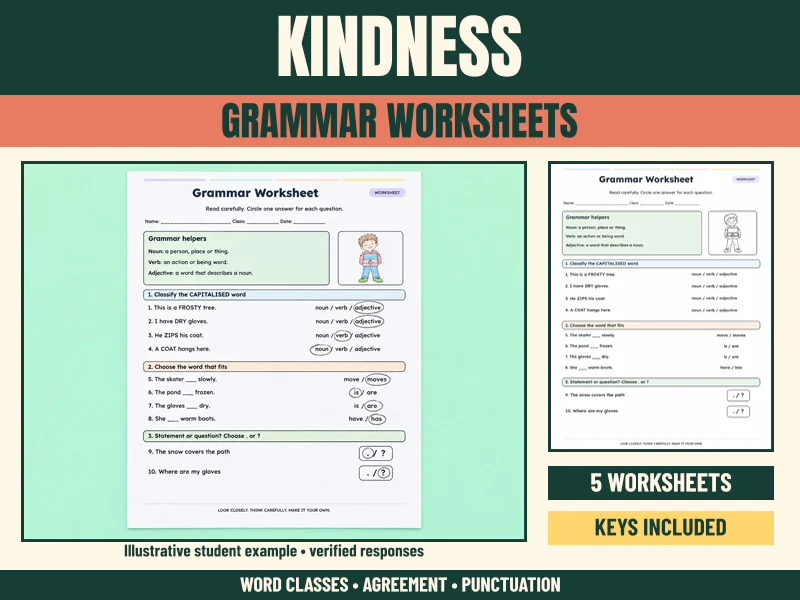
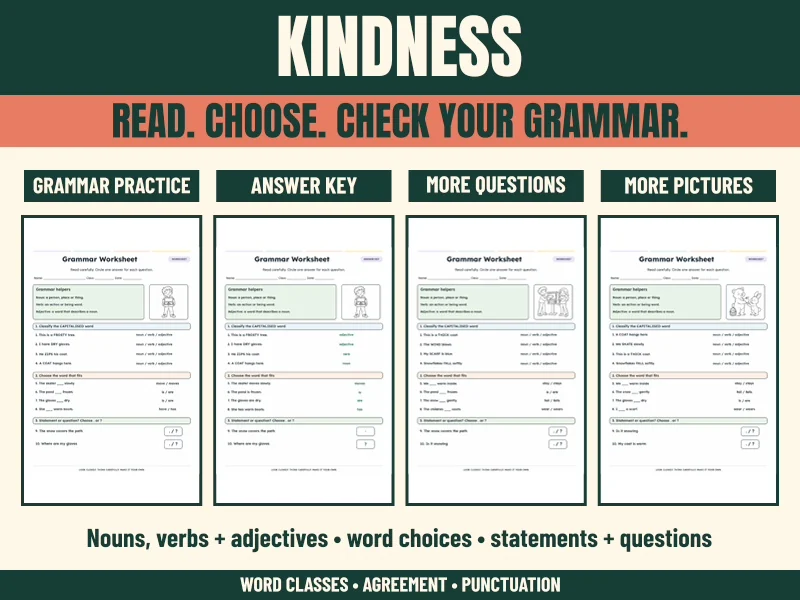
- One 12-page printable PDF
- Five grammar worksheet sets with answer pages, covering nouns, verbs, adjectives, word choices and punctuation
How it works. Read the sentences, classify the capitalised words, select the correct words and identify the punctuation. Check the responses with the included answers.
Discuss one sentence together, then ask children to explain why a highlighted word belongs to a category. Use the answer page to review the reason as well as the result.
Grammar Grid Mystery Pictures
Grammar responses guide the construction of a mystery picture.
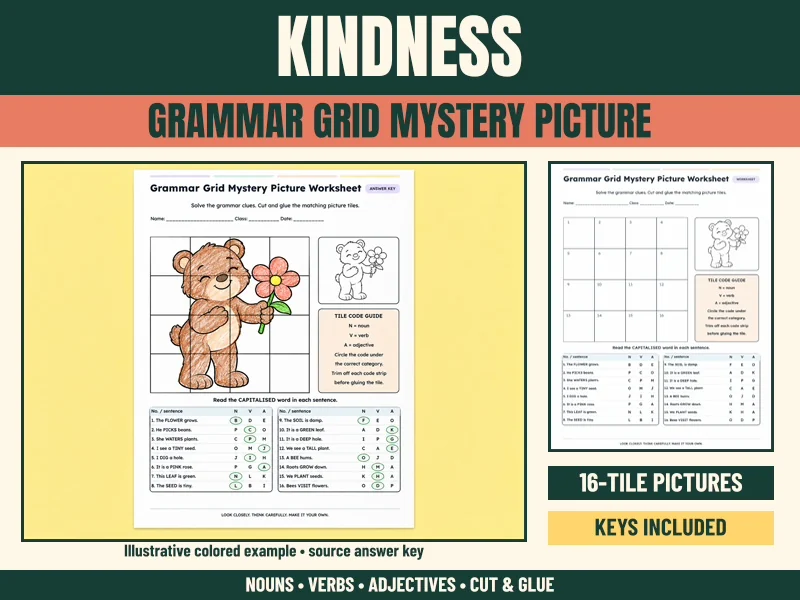
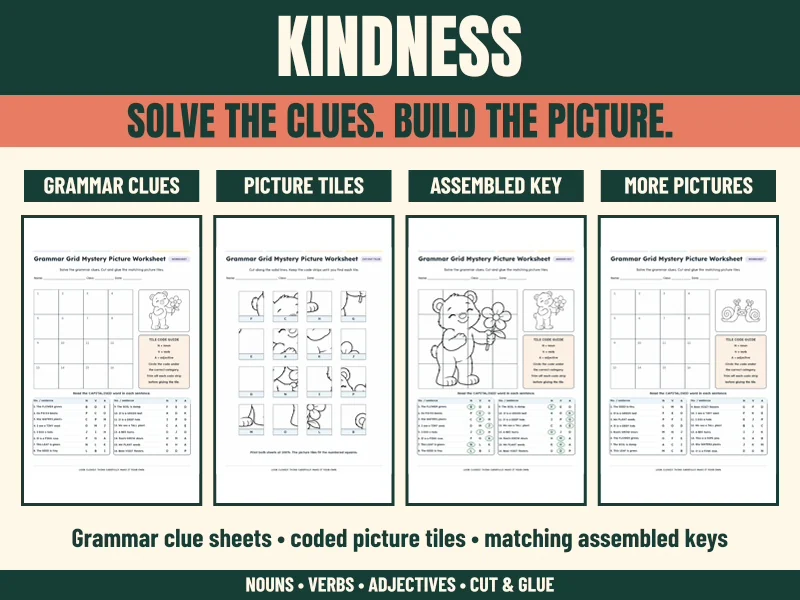
- One 17-page printable PDF
- Five grammar mystery-picture sets with sentence questions, picture grids and completed answer pictures
How it works. Choose the correct response for the capitalised word in each sentence, use the grid directions to reveal the picture and check the completed key.
Have partners justify a word choice before following the grid directions. If the picture looks unexpected, revisit the sentence instead of correcting the drawing by guesswork.
A simple plan for a kindness lesson
- Notice. Discuss one picture or read a story you have selected. Ask what someone did to help and what made the action useful.
- Practise. Choose one literacy, maths or visual task. Demonstrate the first step and give learners a way to ask for support.
- Create or explain. Finish a craft, share a written response or explain a puzzle choice to a partner.
- Connect. Name a small action learners could choose to try in their own classroom. Revisit the idea later without turning kindness into a competition.
Before you download
Are these physical classroom supplies?
No. These are digital PDF resources. You provide the printing and any paper, pencils, colouring or craft materials needed by the chosen activity.
Do the retelling resources include a story?
The retelling and character-analysis activities use a teacher-selected story or a picture discussion. A complete reading passage is not included. Check each product description for its exact contents.
Do I need the whole collection?
No. Each resource is sold separately. Start with one learning purpose and use the cover, sample and included-page details to decide.
Where can I check the current price and download details?
Open the direct product link beside an activity. The official store has the current price, previews and checkout information.
Resource contents checked against the official Printable Lesson Lab product pages on 4 November 2026. Classroom examples are editorial suggestions.